
Building backlinks is not simply about finding websites with impressive authority scores and requesting links. The real challenge is identifying opportunities where another website has a genuine reason to reference our content.
Broken link building is one of those opportunities.
Every day, websites remove articles, change URL structures, discontinue resources and migrate content. When existing backlinks continue pointing towards those unavailable pages, they create problems for website owners and opportunities for SEO professionals.
Instead of approaching publishers with an ordinary backlink request, we can help them identify outdated references and offer relevant, working replacements.
That makes broken link building an appealing approach to editorial link acquisition.
However, the strategy is not as straightforward as finding a 404 error and sending an email.
We need to understand the original content, examine the websites linking to it, assess whether our replacement satisfies the same audience and determine whether outreach is commercially worthwhile.
Through our work in backlink research, content development and publisher outreach, we approach broken link building as a structured acquisition process rather than a numbers game.
In this article, I explain how we evaluate broken-link opportunities, which tools are worth using, how to create replacement content, what businesses should budget and how to measure whether their campaigns are producing valuable backlinks.
What Is Broken Link Building in SEO?
Broken link building is an SEO technique where we identify hyperlinks pointing to unavailable webpages and encourage the linking website to replace them with relevant, working content.
It is also known as dead link building.
The method usually involves three parties:
- A website publishing an article containing an outdated external link.
- The original website hosting the resource that is no longer available.
- Our website offering a relevant replacement resource.
For example, imagine an accounting publication linking to an article called Small Business Tax Planning Checklist.
The original checklist has been deleted and now returns a 404 error.
Our website already offers an updated tax planning checklist covering comparable information.
We contact the publication, explain that the existing reference is unavailable and suggest our working checklist as a possible replacement.
The publisher can then decide whether our resource improves its article.
If accepted, we gain a contextual backlink, the publisher fixes an outdated reference and readers regain access to useful information.
How Broken Link Building Works?
| Stage | What Happens | SEO Opportunity |
| Discovery | We find an unavailable webpage | Identify potential link prospects |
| Backlink analysis | We locate websites linking to that page | Build a prospect list |
| Content evaluation | We investigate the original resource | Understand replacement requirements |
| Content preparation | We select or develop a relevant replacement | Offer genuine editorial value |
| Outreach | We contact the responsible publisher | Request consideration |
| Placement | The publisher updates its existing link | Acquire a contextual backlink |
| Monitoring | We verify and track the placement | Evaluate continuing value |
The important distinction is that broken link building is not an automatic link-replacement service.
The original publisher still decides whether the proposed resource belongs in its content.
Why Is Broken Link Building Important for SEO?
The main advantage is that the outreach begins with an existing editorial problem.
Traditional backlink outreach often asks publishers to add a completely new reference to an article.
Broken link building identifies a reference the publisher has already chosen to include.
That difference matters.
The article has an established reason to reference the original topic. Our task is to demonstrate that another resource can fulfil the same purpose.
1. It Creates Contextual Backlink Opportunities
Links placed naturally within relevant editorial content can provide useful contextual signals.
A cybersecurity publication linking to a detailed phishing-prevention resource makes sense.
An unrelated entertainment article linking to the same resource would require a much stronger explanation.
Our broader approach to effective link building strategies prioritises connections between the referring content, the destination page and the reader’s needs.
2. It Supports Editorial Relationships
A well-researched broken-link notification can introduce our team to an editor without beginning with a purely promotional request.
The relationship may become useful beyond the immediate opportunity.
However, we should not assume that reporting a broken link creates an obligation to give us a backlink.
3. It Makes Better Use of Existing Content
Sometimes, the ideal replacement resource already exists on our website.
If the topic, intent and information are sufficiently close, we may only need to update the content before outreach.
This can be more economical than developing a completely new linkable asset.
4. It Supports Long-Term Content Authority
When multiple relevant websites independently reference a useful resource, those endorsements can help build its online visibility and credibility.
But backlinks are only one component of SEO.
Technical performance, content quality, search intent and internal linking remain important.
Fernando Raymond, SEO Expert, expressed a useful long-term perspective in his published writing:
“My purpose is not to take you to the top of search results. My purpose is to help you stay there.”
That principle is particularly relevant here. Acquiring one backlink is less important than building resources and editorial relationships that remain useful over time.
Does Broken Link Building Still Work in 2026?
Yes, broken link building remains a viable SEO strategy, but its effectiveness depends on the quality of opportunities and the execution.
A campaign involving 500 generic messages to unrelated websites may perform poorly.
A carefully researched campaign involving 50 relevant publishers, strong replacement content and accurate contact information may produce more meaningful opportunities.
We evaluate the strategy using five considerations:
- Whether the unavailable resource has genuinely relevant backlinks.
- Whether the linking pages are actively maintained.
- Whether we can offer an appropriate replacement.
- Whether the publisher has editorial control over the link.
- Whether the expected value justifies the research and outreach cost.
We also distinguish between identifying a broken link and identifying an actionable prospect.
A broken link found on an abandoned website is not automatically a worthwhile opportunity.
Our Editorial Ratings of Broken Link Building Methods
The percentages below represent our editorial assessment of each method’s practical usefulness. They are not measured conversion rates, guaranteed outcomes or results from a controlled campaign.
| Broken Link Building Method | Editorial Rating | Best Application |
| Competitor broken-page research | 94% | Discovering dead resources with established backlinks |
| Topic-specific resource prospecting | 91% | Finding closely relevant editorial opportunities |
| Broken outbound link analysis | 87% | Identifying problems on relevant websites |
| Resource-page prospecting | 84% | Finding educational and industry resource links |
| Wikipedia dead-link research | 70% | Discovering original sources and external linking domains |
| Unfiltered mass outreach | 22% | Generally unsuitable for quality-focused campaigns |
We favour competitor broken-page research because it allows us to begin with an unavailable resource and investigate its existing referring domains.
Resource-page research is useful too, particularly in education, technology, finance and specialist business sectors.
However, neither strategy eliminates the need for manual qualification.
How Do We Find Broken Link Building Opportunities?
We generally use several discovery methods rather than relying on a single platform.
Different tools uncover different types of opportunities, and their backlink indexes may not contain identical information.
Method 1: Find Broken Pages on Competitor Websites
One of the most efficient approaches is analysing competitor webpages that are no longer available but still attract backlinks.
Suppose a competing marketing company previously published a detailed guide about local SEO.
That guide has been removed without an appropriate replacement.
Several marketing publications still link to its original URL.
If we have a suitable guide, those referring publications may become outreach prospects.
Using Ahrefs:
- Open Ahrefs Site Explorer.
- Enter a relevant competitor’s domain.
- Navigate to the Best by links report.
- Apply the HTTP code filter for 404 Not Found.
- Review unavailable pages with referring domains.
- Open the external backlinks associated with promising URLs.
- Export suitable opportunities for qualification.
We prioritise pages with several independent, relevant referring domains rather than simply selecting the URLs with the most individual backlinks.
A single resource can have hundreds of backlinks from only a handful of websites.
Referring-domain diversity therefore helps us understand the actual number of potential editorial relationships.
Compare the same competitors using a backlink gap analysis to understand which publications already reference similar businesses.
This prevents us from treating every discovered website as an equally valuable prospect.
Method 2: Discover Dead Pages Using Semrush
Semrush provides another route to identifying unavailable pages that continue attracting backlinks.
The typical workflow is:
- Open Backlink Analytics.
- Enter a competitor’s domain.
- Navigate to Indexed Pages.
- Enable the Broken Pages filter.
- Identify unavailable pages with relevant backlinks.
- Open their backlink records.
- Inspect the referring articles individually.
The purpose is not merely to export thousands of domains.
We want to identify the specific articles, editors and content sections where a replacement might genuinely be useful.
Semrush can also help us compare authority, link attributes and other characteristics during the qualification stage.
Method 3: Search Resource Pages on Google
Resource pages are particularly useful because their purpose is to recommend external information.
Common examples include:
- University research resources.
- Industry association reading lists.
- Business training materials.
- Technology documentation collections.
- Professional education pages.
- Specialist informational directories.
We use Google search operators to locate relevant collections.
| Google Search Query | What It Helps Find |
| “SEO” intitle:resources | SEO resource collections |
| “digital marketing” inurl:resources | Marketing resource pages |
| “small business” “useful links” | Small-business reference pages |
| “cybersecurity” “recommended resources” | Technology and security resources |
| “accounting” “helpful resources” | Finance-related information pages |
After opening a promising page, we scan its external links using a suitable link checker.
The goal is to find broken resources that are relevant enough for us to replace.
A resource page containing 100 links is not automatically better than one containing 15.
Its subject, editorial quality and current maintenance matter more than the raw link count.
Method 4: Use Check My Links and Website Crawlers
For individual resource pages, browser-based link checkers can make initial research faster.
Check My Links is useful for examining the hyperlinks on an open webpage.
For larger websites, Screaming Frog SEO Spider and other crawlers provide more extensive link analysis.
During an authorised site crawl, we can examine outgoing external links and investigate URLs returning error responses.
It is important to distinguish crawler findings from verified failures.
A link checker can report an error even when the resource is temporarily unavailable to automated requests.
This is why we do not immediately send outreach after a crawler flags a URL.
Method 5: Research Wikipedia Dead References
Wikipedia can help identify historical references and resources that have disappeared.
We can search for relevant articles containing dead-link notices and investigate the unavailable external sources.
However, our main objective should not be replacing Wikipedia references with promotional links.
Instead, we investigate the original dead URL and use backlink-analysis tools to identify other independent publications referencing it.
Those external publications may provide more appropriate opportunities.
How Can We Verify Whether a Link Is Actually Broken?
This is one of the most overlooked parts of broken link building.
A reported error does not always mean that a resource is permanently unavailable.
Before recommending a replacement, we inspect the URL and determine what is happening.
| HTTP Status or Condition | Meaning | Recommended Action |
| 200 | Request succeeded | Confirm the page contains the expected content |
| 301 | Permanent redirect | Check whether the destination remains relevant |
| 302 | Temporary redirect | Investigate the destination before classifying |
| 403 | Access forbidden | Check for permissions or crawler restrictions |
| 404 | Page not found | Verify the resource is genuinely unavailable |
| 410 | Resource intentionally removed | Consider a replacement if relevant |
| 429 | Too many requests | Reduce requests and retry appropriately |
| 500/503 | Server error or unavailable service | Retry later before contacting the publisher |
| Soft 404 | Error-like content returned with a successful status | Inspect manually |
A 404 or 410 is usually a stronger discovery signal than a temporary 403 or 503 response.
But even a 404 can be misleading if a tool is showing outdated crawl information or the website has recently restored its content.
We therefore recheck opportunities before outreach.
Avoiding False-Positive Opportunities
Our practical verification process considers:
The original URL: Does it still return an error when accessed normally?
Redirect behaviour: Has the content moved to another relevant URL?
The referring page: Does the publication still link to that exact unavailable URL?
The content topic: Was the original page genuinely about the topic we intend to replace?
The page’s maintenance: Does the referring website appear active and editorially maintained?
This prevents unnecessary outreach and helps protect relationships with publishers.
How Do We Choose High-Quality Broken Link Prospects?
Not every broken link deserves outreach.
We evaluate the editorial value of the website and the relevance of the specific referring page.
A link from a specialist accountancy publication may be more appropriate for accounting software than a link from an unrelated website with a higher third-party authority score.
This is also why I previously wrote:
“We use third-party authority metrics as comparative indicators, not absolute measurements of how Google ranks a page.”
– Dinesh Kumar VM, Senior SEO Consultant
That distinction is essential.
Domain Authority and Domain Rating can help with comparative research, but neither is an official Google ranking score.
We examine relevance, genuine readership, search visibility, outbound linking patterns and the reason our replacement belongs in the article.
Our Broken Link Opportunity Scoring Framework
To make prospecting more consistent, we can use a weighted editorial score.
| Assessment Factor | Maximum Weight | Evaluation |
| Replacement content relevance | 35% | How closely our content satisfies the original reference |
| Referring page quality | 30% | Editorial credibility, maintenance and usefulness |
| Audience and industry relevance | 20% | Whether the link makes sense to the publication’s readers |
| Contact and placement feasibility | 15% | Whether the responsible editor can reasonably be reached |
| Total | 100% | Overall opportunity score |
For example, a prospect might receive:
- Content relevance: 31 out of 35
- Referring page quality: 24 out of 30
- Audience relevance: 17 out of 20
- Contact feasibility: 10 out of 15
That creates an overall editorial opportunity score of 82%.
This is a hypothetical scoring example, not a prediction that 82% of outreach attempts will succeed.
We might initially prioritise opportunities above 80%, manually review those scoring 60–79%, and deprioritise weaker prospects.
These cutoffs are internal planning choices, not universal SEO standards.
How Do We Create Replacement Content That Publishers Actually Want?
Finding an unavailable webpage is only half the process.
The next challenge is understanding why another website linked to it.
Many campaigns fail because the replacement content is only loosely related to the original resource.
Suppose an article links to a downloadable spreadsheet for managing business expenses.
Offering a general blog post about business finance is unlikely to fulfil the same purpose.
Even if the subject is similar, the content format and reader intent are different.
A downloadable expense tracker with clear instructions would be a much closer replacement.
Research the Original Content First
We can use the Internet Archive’s Wayback Machine to investigate historical versions of unavailable webpages.
This can reveal:
- The original page title and subject.
- Whether the content was a tutorial, study, checklist or tool.
- The approximate information depth.
- The intended audience.
- Which sections were most relevant.
- Whether the resource contained useful data or downloadable materials.
Archived pages are not always available or complete.
When archive records are missing, the anchor text and surrounding paragraphs on referring pages can help us reconstruct what readers expected.
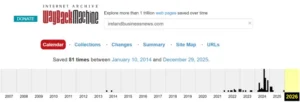
The Wayback Machine displaying an archived version of a deleted webpage to help determine the original resource’s subject and purpose.
Build a Better Resource Without Changing the Intent
Our replacement should preserve the original reason for the backlink while improving the information.
For instance:
| Original Unavailable Resource | Suitable Replacement |
| Outdated SEO checklist | Updated SEO checklist with practical instructions |
| Deleted backlink statistics study | Relevant, transparent data report |
| Missing accounting spreadsheet | Working spreadsheet with clear usage notes |
| Old technical tutorial | Updated tutorial covering the same technical task |
| Discontinued industry glossary | Comprehensive, accessible terminology resource |
| Missing downloadable template | Functional template serving the same purpose |
When developing content for outreach, we focus on accuracy, usability, originality and the reader’s requirements.
Longer content is not automatically better.
A concise, well-maintained calculator may be a stronger replacement than a 4,000-word article if the original link pointed to a calculator.
The same principle applies to internal links.
When a new resource begins attracting backlinks, we examine how relevant internal links can help users navigate towards related material.
Understanding how link equity works is useful when planning that content architecture, although no fixed amount of ranking value can be assigned to an individual link.
How Should We Write Broken Link Building Outreach Emails?
Outreach quality can determine whether a strong opportunity results in a placement.
We prefer short, precise messages that demonstrate actual research.
The recipient should understand which page contains the problem, where the unavailable link appears and why our replacement could be useful.
Our approach to outreach link building places particular emphasis on relevance rather than superficial personalisation.
Adding the recipient’s name to a generic message is not sufficient.
The message should reflect their specific article.
Broken Link Building Email Template
Subject: Broken resource in your article about [topic]
Hi [Name],
I was reviewing your article on [article topic] and noticed that the link to [original resource] in the [section name] section currently leads to an unavailable page.
We have a working resource covering [specific subject], including [relevant feature or information].
Here is the link: [replacement URL]
It may be a useful alternative if you’re updating that section.
Either way, I thought you would appreciate knowing about the broken reference.
Best regards,
[Sender Name]
The message works because it identifies the issue and gives the editor sufficient information to assess the recommendation.
It does not pretend that a relationship already exists.
It also avoids making unrealistic claims about the SEO benefits of replacing the link.
Follow-Up Email Template
Subject: Re: Broken resource in [article title]
Hi [Name],
Just following up on the unavailable reference I spotted in your [article title] article.
The replacement resource is still available if it would be useful for your readers.
No problem if it isn’t suitable.
Thanks,
[Sender Name]
We generally prefer a limited follow-up sequence over repeated messages.
For example, an internal workflow might schedule one follow-up approximately five working days after the initial email and a final brief message a week later.
This is a suggested operating cadence, not a claim that these intervals produce a particular response rate.
If a publisher declines or requests no further contact, we respect that decision.
Common Outreach Mistakes
Generic mass emails are especially problematic when they report links that are not actually broken.
Other mistakes include:
- Using an irrelevant replacement URL.
- Contacting the wrong editor.
- Making the email unnecessarily long.
- Sending multiple requests to the same publisher.
- Demanding a dofollow backlink.
- Offering content without checking its accuracy.
- Automatically generating personalised messages without verification.
AI tools can assist with organising prospects and drafting outreach, but manual checks remain important.
An inaccurate message can damage the credibility of an otherwise worthwhile campaign.
Which Tools Are Best for Broken Link Building?
The most suitable toolkit depends on the campaign size and the resources already available.
Smaller businesses may begin with free checks and targeted manual research.
Agencies managing hundreds of prospects generally benefit from more extensive backlink databases and outreach management systems.
| Tool | Main Use | Our Editorial Suitability Rating |
| Ahrefs | Competitor broken-page and backlink discovery | 95% |
| Semrush | Broken-page research and broader SEO analysis | 93% |
| Screaming Frog SEO Spider | Crawling and validating website links | 91% |
| Wayback Machine | Investigating historical resource content | 90% |
| Check My Links | Inspecting links on individual webpages | 85% |
| BuzzStream | Managing outreach and follow-ups | 89% |
| Google Search Console | Monitoring our own site’s search and link data | 84% |
These percentages are our qualitative suitability ratings for this particular workflow. They are not independently tested accuracy scores or performance guarantees.
We would not purchase several overlapping SEO platforms solely for a small broken-link-building campaign.
Instead, we would first determine whether the limiting factor is discovery, verification, contact research or outreach management.
Our comparison of link building tools explains how the main platforms support different stages of backlink acquisition.
For businesses with smaller budgets, free and paid backlink checking tools can provide a practical starting point.
How Much Does Broken Link Building Cost?
Broken link building is frequently described as a free backlink strategy.
That description can be misleading.
While an editorial publisher may choose to add our link without charging a placement fee, the campaign still consumes time and resources.
Costs can include research, software subscriptions, content production, outreach administration, verification and monitoring.
Example of a Broken Link Building Campaign Budget
Consider a hypothetical campaign involving 120 delivered outreach emails.
| Campaign Expense | Illustrative Cost |
| Prospect research and outreach: 18 hours at £35/hour | £630 |
| Allocated SEO and outreach software costs | £150 |
| Content improvements and replacement preparation | £220 |
| Total Campaign Cost | £1,000 |
Now suppose the same illustrative campaign secures eight editorial backlinks.
The cost per acquired backlink would be:
£1,000 ÷ 8 = £125 per backlink
This is a worked example, not a reported result from our agency or a published market-average price.
The actual cost could be substantially higher or lower.
A campaign requiring a specialised research report or interactive tool may be more expensive than one using existing content.
Likewise, the cost per link increases if only two publishers accept the proposed replacement.
Is Broken Link Building More Cost-Effective Than Guest Posting?
Both methods have distinct advantages.
| Factor | Broken Link Building | Guest Posting |
| Primary opportunity | Replacing an unavailable reference | Publishing a new editorial contribution |
| Content requirement | Relevant existing or new resource | Usually a new article |
| Initial research | Broken-link and backlink analysis | Publisher and topic research |
| Editorial control | Publisher chooses whether to update | Publisher reviews a proposed contribution |
| Content production cost | Potentially lower if a match already exists | Usually requires dedicated writing |
| Scalability | Limited by suitable dead resources | Depends on publisher access and content capacity |
| Main strength | Existing context for the link | Opportunity to contribute new expertise |
Where suitable broken-link opportunities are limited, businesses may prefer editorial guest posting services rather than spending excessive time chasing weak prospects.
Another alternative is approaching publishers about genuinely useful additions to existing articles.
These are sometimes called niche edits or link insertions.
However, niche edits should not be confused with broken link building.
One involves suggesting a useful contextual addition to an existing page; the other begins with an unavailable reference.
Neither method guarantees editorial acceptance or a particular ranking improvement.
How Do We Measure Broken Link Building Success?
Counting acquired backlinks is useful, but it provides only a partial view of campaign performance.
We also need to understand how efficiently those backlinks were acquired, whether they remain live and whether they support our wider SEO objectives.
Core Performance Metrics
| Metric | Formula | What It Measures |
| Delivery rate | Delivered emails ÷ Sent emails × 100 | Contact-data and delivery quality |
| Response rate | Unique replies ÷ Delivered emails × 100 | Outreach engagement |
| Link placement rate | Acquired links ÷ Delivered emails × 100 | Overall acquisition effectiveness |
| Reply-to-placement rate | Acquired links ÷ Unique replies × 100 | Conversion after a reply |
| Cost per link | Total campaign cost ÷ Acquired links | Financial efficiency |
| Link retention rate | Remaining live placements ÷ Acquired placements × 100 | Placement durability |
We should maintain consistent definitions, particularly when comparing multiple campaigns.
Example: Calculating Campaign Conversion Rates
Suppose our hypothetical campaign produces the following results:
| Campaign Metric | Illustrative Result |
| Delivered outreach emails | 120 |
| Unique replies | 18 |
| Editorial backlinks acquired | 8 |
| Response rate | 15% |
| Placement rate | 6.7% |
| Reply-to-placement rate | 44.4% |
These percentages illustrate the calculations only. They are not company performance claims or industry benchmarks.
A low response rate may indicate poor prospect targeting, inaccurate contacts or weak messaging.
A reasonable response rate but low placement rate may indicate that our replacement content is not strong enough.
A good placement rate with an excessive cost per link may mean that the process is too labour-intensive.
That diagnostic approach is more useful than celebrating a large outreach volume.
How Should We Track the Acquired Backlinks?
Once a publisher updates a link, we record:
- The referring domain and exact referring URL.
- The new destination URL.
- The date the backlink was first observed.
- The visible anchor text.
- Whether the referring page remains publicly accessible.
- Relevant link attributes.
- The page’s contextual relevance.
- Any subsequent removal or destination change.
We also monitor new and lost referring domains.
Our assessment of backlink monitoring tools explains how ongoing verification supports link management after the initial placement.
Can Broken Link Building Increase Organic Traffic?
Relevant backlinks may contribute to stronger search visibility over time.
However, it is incorrect to assume that one acquired link produces a fixed percentage improvement in rankings or traffic.
Changes in organic performance can reflect several factors, including content updates, competitor activity, technical improvements and wider search changes.
We therefore monitor target-page performance over an appropriate period using Google Search Console and analytics data.
Useful indicators include organic impressions, clicks, relevant keyword visibility, referral traffic and conversions.
We treat any relationship between new links and ranking improvements as evidence to investigate, not automatic proof of causation.
What Are the Biggest Broken Link Building Mistakes?
The most expensive mistakes are often strategic rather than technical.
1. Choosing Links Based Only on Domain Authority
An attractive authority score does not make a website editorially relevant.
We prefer a credible page that genuinely serves the intended audience over an unrelated high-scoring domain.
2. Ignoring the Original Resource’s Purpose
A broken link pointing to a downloadable checklist should not automatically be replaced with a generic sales page.
The replacement must serve the reader’s original need.
3. Contacting Abandoned Websites
An unmaintained website may contain numerous broken links but have no active editor available to update them.
Research time can be wasted when outreach prospects are not qualified.
4. Treating Every Error as a Permanent 404
Crawler restrictions, server problems and temporary responses can produce misleading reports.
We verify URLs before contacting publishers.
5. Reusing Generic Outreach Messages
Publishers are more likely to understand a recommendation when the email identifies their exact article and the relevant broken reference.
Personalisation should demonstrate useful research.
6. Overlooking Link-Spam Policies
Broken link building works best as a genuine editorial recommendation.
Paying for links primarily to manipulate rankings introduces a different set of risks.
Google’s link-spam policies prohibit manipulative paid-link arrangements that pass ranking credit. Paid advertising or sponsored placements should be appropriately qualified with attributes such as rel=”sponsored” or rel=”nofollow”.
An editorially justified replacement should not require payment in exchange for passing ranking credit.
7. Forgetting to Monitor Published Links
A link may later disappear because the publisher updates its article, removes the page or changes its URL.
Broken link building therefore requires follow-up monitoring, not just initial placement reporting.
How Should UK Businesses Build a Broken Link Campaign?
For a UK business investing in SEO, the strategy should begin with commercially relevant topics.
A property company may benefit from links to a detailed landlord compliance resource.
An accounting firm may create useful tax-planning materials.
A cybersecurity business may offer research-backed technical checklists.
The common feature is that the replacement content should be relevant to the company’s expertise and genuinely useful to the referring publication.
A Practical 30-Day Campaign Framework
| Period | Main Activity | Intended Deliverable |
| Days 1–5 | Competitor research and broken-link discovery | Initial prospect database |
| Days 6–10 | URL verification and editorial qualification | Prioritised opportunity shortlist |
| Days 11–15 | Content mapping and improvements | Publication-ready replacement resources |
| Days 16–22 | Personalised publisher outreach | Initial outreach completed |
| Days 23–27 | Follow-up and publisher communication | Responses reviewed and acted on |
| Days 28–30 | Link verification and campaign analysis | Performance report and next actions |
This is a planning framework rather than a guaranteed completion schedule.
Some publishers respond quickly, while others may take weeks or never respond.
We also avoid forcing link acquisition into arbitrary deadlines.
If the research produces only 20 genuinely suitable prospects, we would rather contact those 20 than manufacture another 80 weak opportunities simply to reach a numerical target.
Businesses managing several outreach methods simultaneously may benefit from broader link building services, particularly where research, content production and publisher relationship management must be coordinated.
The objective should be profitable, sustainable organic visibility rather than acquiring backlinks for their own sake.
Final Thoughts
Broken link building remains worth considering when a business has useful content, access to relevant backlink research and the resources to conduct targeted outreach.
But it should not be treated as a guaranteed shortcut to higher Google rankings.
Finding a 404 page is easy compared with understanding why somebody linked to it and creating a resource the publisher would reasonably prefer.
Our approach focuses on the quality of that match.
We identify unavailable resources with meaningful backlinks, verify that they are genuinely broken, examine the original purpose, assess the referring publication and recommend content that improves the reader’s experience.
We then evaluate the campaign through acquisition costs, editorial quality, link retention and broader organic search performance.
For businesses, the central question is not how many broken links exist across the internet.
It is how many relevant opportunities can be converted into worthwhile editorial references without wasting research time or compromising quality.
The strongest broken link building campaigns begin with useful content and end with links that make sense for the reader.
That is the standard we aim to maintain across our link-building work.
Frequently Asked Questions About Broken Link Building
Is Broken Link Building a White-Hat SEO Strategy?
Broken link building can be a legitimate, white-hat SEO technique when publishers independently choose to reference relevant, useful replacement resources.
It becomes problematic when the process relies on deceptive outreach, irrelevant links, manipulative payment arrangements or artificial linking networks.
The editorial purpose of the link matters more than the label attached to the technique.
Can We Do Broken Link Building Without Paid Tools?
Yes. Manual Google searches, browser link checkers, free backlink tools and public archives can help identify opportunities.
However, paid backlink databases generally make it easier to discover unavailable resources with substantial existing referring-domain profiles.
The best option depends on the campaign’s scale and available research time.
How Many Backlinks Can We Get From Broken Link Building?
There is no reliable universal number.
Results depend on the quality of the replacement resource, prospect relevance, publisher responsiveness, contact accuracy and the effort invested.
We recommend tracking actual campaign results rather than relying on generic promises about how many backlinks a particular outreach volume will produce.
Is Broken Link Building Better Than Guest Posting?
Neither strategy is universally better.
Broken link building can be attractive when relevant unavailable resources have existing backlinks.
Guest posting may provide more opportunities to contribute original expertise and reach new readers.
The better method depends on the business, content assets, audience and available publishers.
Should We Replace Every Broken Link We Find?
No. We only pursue opportunities where our content is a genuinely appropriate replacement and the referring website passes our editorial checks.
An irrelevant backlink is not worth pursuing simply because its original destination is unavailable.
Do Broken Link Building Backlinks Have to Be Dofollow?
No. Link attributes are only one consideration. A relevant editorial reference may contribute referral traffic, brand exposure and reader trust even when it does not pass conventional ranking credit.
We should not pressure publishers into changing link attributes purely to influence rankings.
How Long Does Broken Link Building Take?
Prospecting and verification can be completed relatively quickly for a narrow campaign, but content creation, publisher responses and placements are less predictable.
It may take days to prepare the initial shortlist and several weeks or longer for the full outreach process.
Ranking changes, if any, can take additional time and cannot be guaranteed.
Can AI Help With Broken Link Building?
AI can support prospect classification, content planning, email drafting and administrative tasks.
However, verification of URLs, replacement relevance, publisher credibility and communication accuracy still requires appropriate human oversight.
Automating incorrect or misleading outreach at scale can create significant reputational problems.
