

Building backlinks is not simply about increasing the number of websites linking to a business. The real challenge is finding links that connect with the website’s industry, subject matter, audience and commercial objectives.
A website could attract hundreds of backlinks and still struggle to improve its organic visibility if those links have little contextual relevance.
Meanwhile, a smaller number of carefully selected editorial links can offer stronger opportunities for search visibility, referral traffic and brand credibility.
Through our work in SEO, publisher outreach and link-building campaigns, we approach backlink relevance as a question of quality rather than quantity.
In this article, we explain what relevant backlinks are, how to judge their quality, where to find them, which acquisition strategies deserve attention and how businesses can evaluate the return on their link-building investment.
What Are Relevant Backlinks in SEO?
Relevant backlinks are hyperlinks from external webpages that have a meaningful relationship with the subject, industry or audience of the page receiving the link.
For example, a website offering accounting software might earn a relevant backlink from an article discussing bookkeeping automation, financial reporting or small business accounting.
The connection between the two pages makes the reference useful to readers.
By contrast, a backlink from an unrelated gaming article would have a much weaker contextual connection unless the article had a legitimate reason to discuss the accounting product.
We normally assess backlink relevance through four connected dimensions:
- Topical relevance: Whether the linking content discusses the same or a closely related subject.
- Industry relevance: Whether the publisher operates within a relevant business sector.
- Audience relevance: Whether readers of the linking page would be interested in the destination.
- Geographical relevance: Whether the publisher serves a location that matters to the business.
A backlink does not need to satisfy all four dimensions equally. An international technology publication, for example, could provide a highly relevant reference to a UK software company without being based in Britain.
The important question is whether the link makes sense within the editorial context.
Why Are Relevant Backlinks Important for Google Rankings?
Links help search engines discover webpages and understand relationships between online resources.
A relevant editorial backlink can provide context about the destination page and may contribute to the signals used to evaluate that content.
However, backlinks are not independent ranking guarantees. Search performance also depends on content quality, technical accessibility, search intent, competition and other factors.
We therefore evaluate backlinks as part of a wider SEO strategy.
They Strengthen Topical Connections
When a financial publication links to a specialist article about business taxation, the connection between the subjects is clear.
Repeated, genuinely earned references from relevant publications can contribute to a website’s broader authority and visibility within its subject area.
They Can Generate Qualified Referral Traffic
A backlink from an industry publication may attract visitors who already have an interest in the services or information being offered.
These visitors can be more commercially relevant than visitors arriving from unrelated websites.
They Support Brand Visibility
Editorial mentions help introduce a business to audiences outside its existing customer base.
They can also create opportunities for future partnerships, enquiries and further coverage.
They Can Support Internal Website Authority
Backlinks often point to informational resources rather than commercial landing pages.
Effective internal linking can help readers and search engines navigate from those resources towards related pages.
Our analysis of how link juice works explains why the relationship between external backlinks and internal website structure deserves attention.
What Makes a Backlink Highly Relevant?
A backlink’s value cannot be determined by one domain metric.
Our approach considers the linking website, the individual webpage, the placement and the experience of the reader.
| Relevance factor | What we examine | Importance |
| Topic alignment | Relationship between the linking article and destination | Very high |
| Publisher credibility | Editorial standards, reputation and content quality | Very high |
| Audience compatibility | Whether readers are likely to value the destination | High |
| Contextual placement | Position and surrounding explanation of the backlink | High |
| Page-level strength | Backlinks and visibility of the linking page | High |
| Geographical fit | Relevance to the intended target market | Depends on campaign |
| Anchor text | Whether the linked words describe the destination naturally | High |
| Link attributes | Whether the relationship is properly qualified | Essential |
A link from a high-authority domain can still be poorly matched to its destination.
For this reason, we review the individual page rather than relying exclusively on the reputation of the domain.
Domain Relevance Versus Page Relevance
Consider a national business publication covering finance, recruitment, technology and entrepreneurship.
Its website may not specialise in SEO. However, an article discussing digital marketing budgets could provide a relevant context for linking to a detailed link-building cost analysis.
This shows why page-level relevance can sometimes matter more than the publisher’s broad category.
Contextual Relevance
The words surrounding a hyperlink help explain why a particular destination has been referenced.
For example:
“A successful SEO strategy should include relevant content development, technical optimisation and high-quality backlink acquisition.”
A natural reference to a useful resource about backlink acquisition would fit that paragraph.
A link to an unrelated car insurance comparison page would not.
How Do We Score Relevant Backlinks? Our Percentage-Based Evaluation Framework
We use a weighted evaluation model to make backlink assessments more consistent.
The framework below is a practical editorial decision-making model. It is not a Google ranking formula or a measurement of how much PageRank a backlink passes.
| Assessment category | Weight |
| Topical and page-level relevance | 30% |
| Publisher credibility and editorial quality | 20% |
| Audience and geographical relevance | 15% |
| Contextual placement and natural anchor text | 15% |
| Linking-page strength and traffic potential | 10% |
| Technical quality and appropriate link attributes | 10% |
| Total | 100% |
We place the largest weight on topical relevance because a backlink should first make editorial sense.
Publisher credibility follows closely. A highly relevant page published on a low-quality, manipulative website is not automatically a desirable link.
How We Interpret the Scores?
| Score | Assessment | Recommended action |
| 90–100% | Exceptional candidate | High-priority opportunity |
| 80–89% | Strong candidate | Prioritise |
| 70–79% | Good candidate | Consider when objectives align |
| 60–69% | Moderate candidate | Review carefully |
| 40–59% | Weak candidate | Usually deprioritise |
| Below 40% | Poor candidate | Generally reject |
These thresholds help organise outreach work. They do not guarantee rankings, traffic growth or search-engine approval.
We also apply independent rejection criteria for websites showing clear signs of manipulation, deceptive publishing, malware or other serious quality problems.
A numerical score should never override those concerns.
Practical Example: Three Backlink Opportunities
Imagine a UK accounting software business comparing three potential publishers.
| Factor | Publisher A | Publisher B | Publisher C |
| Topic match /30 | 29 | 12 | 4 |
| Editorial credibility /20 | 18 | 17 | 4 |
| Audience fit /15 | 14 | 6 | 2 |
| Contextual placement /15 | 14 | 5 | 2 |
| Page strength /10 | 7 | 9 | 1 |
| Technical quality /10 | 10 | 9 | 5 |
| Total rating | 92% | 58% | 18% |
These are illustrative scores for hypothetical placements, not results from a live publisher audit.
Publisher A is an established accounting or finance publication with a relevant article and a natural editorial reason to link.
Publisher B has stronger general recognition but publishes the backlink in a less relevant context.
Publisher C offers minimal subject alignment and weak editorial credibility.
We would prioritise Publisher A, even if Publisher B reported a higher third-party domain authority metric.
This is an example of why link-building decisions should go beyond impressive-looking numbers.
How Can You Find Relevant Backlinks for Your Website?
Relevant link prospecting begins with understanding the content and competitors within a market.
We typically organise discovery into a series of manageable steps.
Step 1: Audit Existing Backlinks
Before searching for new backlinks, establish which links the website already has.
Google Search Console provides information about external linking sites, linked pages and commonly used anchor text.
To start:
- Open Google Search Console.
- Choose the verified website property.
- Navigate to Links.
- Review the Top linking sites report.
- Examine the Top linked pages report.
- Review the linking text.
- Export the available information for further analysis.
The report is a sample of links known to Google, rather than a complete record of every backlink.
Step 2: Evaluate the Existing Backlink Profile
The next task is to understand whether the existing links provide meaningful coverage across relevant industries and topics.
We examine:
- Referring domains and individual linking pages.
- Anchor text and link context.
- Publisher quality and potential traffic.
- The destinations receiving links.
- Whether important business pages are underrepresented.
- Lost, redirected and broken backlinks.
- Repeated placements from the same publishers.
A website might have 500 backlinks but only a small proportion that support its most important subjects.
The number alone is therefore insufficient for assessing the profile.
Our comparison of SEO tools to check backlinks examines different options for backlink monitoring and analysis.

Backlink analysis interface showing referring pages, authority metrics, anchor text and traffic-related indicators.
Step 3: Analyse Competitors’ Relevant Links
Competitor research helps identify publications that already cover the subjects a business wants to rank for.
For example, a UK cybersecurity company might analyse competing websites ranking for:
- Managed cybersecurity services
- Small business cyber protection
- Network security solutions
- Cybersecurity risk assessment
- Data protection for businesses
The purpose is to discover which publications reference competing resources and why.
A useful backlink gap analysis compares several competitors rather than copying one website’s backlink profile.
We look for referring domains that link to multiple relevant competitors but do not yet link to the business being analysed.
Those domains are possible prospects, not automatically qualified opportunities.
Step 4: Search for Industry Publications
Google search operators can help identify relevant publishers.
For example, a UK business offering HR software might search for:
- HR technology “write for us”
- employee management “guest contributor”
- UK business software “human resources”
- payroll software “expert opinion”
- workplace technology “research report”
These searches help uncover publications, resource pages and editors who already discuss related subjects.
However, accepting guest contributions is not proof of quality.
Every opportunity still requires manual assessment.
Step 5: Identify the Right Contact
Once a prospective publication passes the quality review, identify its editor, content manager or relevant journalist.
We prefer outreach that explains the value of a proposed resource or editorial contribution.
A generic message asking for a backlink provides very little reason for a publisher to respond.
An effective approach explains the topic, the relevance to the publisher’s audience and the benefit of including the proposed resource.
Our outreach link-building strategies explore the process of identifying prospects, communicating with editors and building publisher relationships.
Which Types of Relevant Backlinks Are Worth Building?
Different acquisition methods suit different business objectives.
The following methods can create valuable opportunities when they are used for legitimate editorial purposes.
Editorial Backlinks
Editorial backlinks occur when a publisher independently chooses to reference a business, research resource or article.
These are especially valuable opportunities because the link is included for the reader’s benefit.
For example, a journalist reporting on changes in UK employment practices may reference a company’s original research on recruitment costs.
The reference can provide both topical relevance and qualified visibility.
Guest Posting
Guest posting involves contributing useful content to another publication.
For example, a cybersecurity specialist could contribute an article about managing workplace security risks to a business technology publication.
The article should provide genuine editorial value rather than existing primarily to insert keyword-rich links.
Our guest posting services cover the practical publishing process, including topic selection, editorial review and contextual content development.
When guest-post placements involve payment, commercial arrangements or ranking manipulation, Google’s link qualification and spam policies must be considered.
Niche Edits and Link Insertions
A niche edit involves adding a link to an existing article.
For example, a published article about improving website security might benefit from linking to a newer, more comprehensive security checklist.
The link can be editorially useful if the destination genuinely improves the original resource.
Our explanation of niche edits and contextual link insertions covers how such placements work and what businesses should inspect.
An insertion should not be treated as safe merely because it appears inside an existing article. Editorial justification and compliance remain essential.
Digital PR Backlinks
Digital PR can help businesses earn relevant coverage by offering journalists original information.
Potential assets include:
- Industry research and surveys.
- Data-led market reports.
- Expert commentary.
- Original case studies.
- Detailed comparisons.
- Useful statistics supported by a transparent methodology.
For example, a payroll software company could release research about administrative costs faced by UK employers.
A journalist covering small business efficiency might reference that research naturally.
This approach can create industry-relevant mentions while strengthening brand awareness.
Broken Link Building
Broken link building involves identifying external references that no longer work and proposing a genuinely useful replacement.
Suppose a business publication links to a discontinued guide about workplace pensions.
If a financial services company publishes a current, accurate alternative, it may contact the editor and explain that the existing link is broken.
The editor is free to decide whether replacing the reference improves the article.
This method works best when the replacement genuinely matches the original resource’s purpose.
Linkable Content Assets
Some content is naturally more useful as a reference than other content.
Examples include original research, free tools, calculators, technical explanations, industry datasets and comprehensive tutorials.
A mortgage calculator, for instance, might attract links from property and financial education publications if it is accurate and genuinely useful.
Our overview of link-building strategies covers additional acquisition approaches and their practical applications.
How Important Are Anchor Text and Surrounding Content?
Anchor text is the clickable text used in a hyperlink.
It helps readers understand where a link will take them and can provide contextual information to search engines.
However, repeatedly using exact-match commercial anchor text can create an unnatural linking pattern.
Consider a page about commercial cleaning services.
Natural anchor variations might include:
- Commercial cleaning solutions
- Professional office cleaning
- Workplace cleaning requirements
- The company’s brand name
- A relevant research article about office hygiene
The correct choice depends on the sentence and the destination page.
We do not recommend fixed percentages for branded, exact-match and partial-match anchor text across every website.
An effective anchor profile should emerge from genuine editorial use rather than an arbitrary numerical target.
Are High-DA Backlinks Always Better Than Relevant Backlinks?
No.
Domain Authority and Domain Rating are third-party SEO metrics. They can help compare websites, but neither represents Google’s internal evaluation of a particular link.
A website with a very high domain score might publish an article with little relevance to the linked business.
Meanwhile, a specialist publication with a lower score could provide a much more meaningful industry reference.
Consider two hypothetical opportunities:
| Metric | Backlink A | Backlink B |
| Domain Rating | 82 | 46 |
| Topic relevance | Low | Very high |
| Audience match | Weak | Strong |
| Linking-page content | Generic | Specialist |
| Editorial justification | Limited | Clear |
| Potential qualified traffic | Uncertain | Stronger audience fit |
In this example, Backlink B deserves serious consideration despite the lower domain metric.
That does not mean that lower-authority sites are automatically better.
The objective is to balance relevance, quality, audience and page-level strength instead of choosing on one number.
What Do Our SEO Specialists Say About Relevant Backlinks?
A recurring theme in our link-building approach is the importance of researching the niche before investing in placements.
Dinesh Kumar VM, Senior SEO Consultant, previously explained this principle in his published link-building book overview:
“When it comes to SEO, there is no written script to rank a website.”
That observation is relevant because different industries require different backlink strategies.
A local removal company may benefit from links associated with property management, waste disposal, London businesses and regional publications.
A software company might benefit from industry research websites, technology publications and specialist resources.
A single publisher list cannot adequately serve every business.
Fernando Raymond, SEO Expert, has also discussed the importance of useful content and authentic editorial referencing in his published writing.
“My final words are creating blogs to add value to the web and publish really good content.”
His point reinforces the distinction between building a webpage solely to place links and creating content that readers genuinely benefit from.
We regard that distinction as central to sustainable link acquisition.
Neither statement should be interpreted as a promise that particular backlinks will improve rankings.
What Are the Biggest Mistakes Businesses Make When Building Relevant Backlinks?
Several common mistakes can reduce the efficiency of a link-building campaign.
Prioritising Quantity Over Quality
A campaign reporting 100 backlinks may appear impressive, but the total says little about the links’ relevance, editorial legitimacy or commercial usefulness.
Relying Entirely on Domain Metrics
A high-DR website can still contain weak, irrelevant or spam-oriented pages.
Always inspect the proposed linking article.
Ignoring the Target Audience
A link might be technically relevant to an industry while attracting readers who have no interest in the business’s products or services.
Overusing Commercial Anchor Text
Repeated use of the same exact-match phrase can make placements look artificial.
Ignoring Existing Backlinks
A business may continue pursuing new links while previously earned backlinks point to deleted or redirected pages.
Link reclamation can sometimes be a better first investment.
Buying Links Solely to Manipulate Rankings
Google’s spam policies identify buying or selling links for ranking purposes as link spam.
Payments, sponsored articles or advertorials are not inherently prohibited, but commercial links need appropriate qualification, generally through rel=”sponsored” or rel=”nofollow”.
A natural-looking paragraph does not make a paid ranking-manipulation link compliant.
Assuming Every Irrelevant Link Is Harmful
Not every backlink needs to originate from the same industry.
Businesses naturally receive references from local organisations, broader news outlets, business partners and other related sectors.
We distinguish an ordinary less-relevant link from a deliberate manipulative linking pattern.
Can Irrelevant Backlinks Harm Your SEO?
Irrelevant backlinks are not automatically harmful.
A business may receive links from various websites as part of its normal online activity.
The more important distinction is between legitimate references and links deliberately created to manipulate rankings.
Potential warning signs include:
- Large numbers of automated or artificial links.
- Links embedded in unrelated content without editorial justification.
- Websites existing primarily to sell ranking links.
- Repeated keyword-rich links across unrelated publications.
- Manipulative link exchanges.
- Links from compromised or hacked pages.
Google may ignore links it considers manipulative and can take further action against serious spam-policy violations.
Businesses should not automatically disavow backlinks simply because an SEO tool assigns them a low score.
Google advises that disavowal is generally relevant when there are substantial artificial or spammy links and a manual action has occurred or is likely.
We recommend inspecting the evidence before removing links or submitting disavowal files.
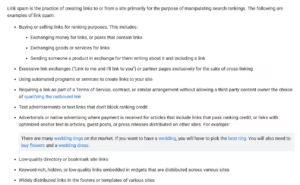
Google’s official link spam policy explaining prohibited ranking manipulation and the correct qualification of commercial backlinks.
How Much Should Businesses Invest in Relevant Backlinks?
The appropriate investment depends on competition, industry, content quality, outreach difficulty and business objectives.
Instead of purchasing backlinks based only on volume, we recommend evaluating the total cost of gaining a qualified editorial reference.
For example, suppose a business allocates £1,200 towards an outreach campaign.
| Campaign outcome | Illustrative cost |
| Campaign expenditure | £1,200 |
| Qualified links earned | 4 |
| Average cost per qualified link | £300 |
Now compare an alternative campaign offering 20 placements for the same £1,200.
Its cost per placement is only £60, but that lower figure does not establish better value.
The business still needs to evaluate the editorial legitimacy, quality, audience relevance and potential commercial contribution of those links.
A cheaper placement may provide little useful exposure. Equally, an expensive placement is not automatically a good investment.
The sensible comparison is between qualified outcomes, not simply the number of URLs delivered.
We also encourage businesses to evaluate whether the target pages are ready to benefit from additional visibility.
A poorly structured service page, weak conversion process or inaccurate content may limit the commercial return from even a strong campaign.
How Do We Measure the Performance of Relevant Backlinks?
A link-building campaign should have clear objectives before outreach begins.
Counting newly acquired backlinks is useful for operational reporting, but it is not enough to establish SEO success.
We prefer measuring several performance indicators together.
| KPI | What it tells us |
| Qualified referring domains | Growth in vetted, distinct backlink sources |
| Link retention | Whether acquired links remain live |
| Organic impressions | Changes in search visibility |
| Organic clicks | Changes in search traffic |
| Target keyword positions | Direction of ranking movements |
| Referral traffic | Visits arriving directly through backlinks |
| Conversions | Enquiries, leads or purchases |
| Cost per qualified link | Efficiency of acquisition |
| Organic conversion value | Commercial performance of search traffic |
Measure Before and After the Campaign
For an illustrative campaign, suppose a target page receives 2,000 monthly organic impressions before link acquisition and 2,600 after the measurement period.
The change is:
Organic impression growth = (2,600 − 2,000) ÷ 2,000 × 100 = 30%
That represents a 30% increase in impressions.
It does not establish that the backlinks alone caused the growth.
Changes in content, search demand, competition, website structure and search-engine systems could also contribute.
We recommend recording major SEO changes during the same period and comparing relevant pages against suitable benchmarks.
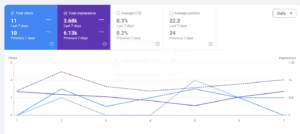
Google Search Console performance comparison showing changes in search impressions, clicks and average position across two selected periods.
Track Backlink Retention
A backlink does not necessarily remain unchanged after publication.
Publishers may update articles, move pages, remove references or change link attributes.
Ongoing monitoring helps identify these changes.
The aim is to distinguish genuine editorial updates from technical problems or unexpected losses.
How Should UK Businesses Build a Relevant Backlink Strategy?
For UK businesses, industry context and the target market should influence publisher selection.
We usually begin by categorising backlink opportunities into three groups.
Core industry publications: Websites directly connected to the company’s products, services or expertise.
Adjacent industry publications: Websites serving a related audience or discussing connected business problems.
Broader relevant publications: Regional media, business news and specialist resources where the company can make a legitimate contribution.
Consider a London-based waste removal company.
Its strongest backlink opportunities might include home renovation publishers, property management websites, construction trade publications and relevant London business resources.
A general UK news article about a local business expansion could also provide a legitimate reference.
A random article about cryptocurrency trading, however, would offer little relevant context for the same business.
International backlinks can still be useful when their subject matter or readership aligns with the company’s objectives.
A .co.uk domain extension alone does not establish UK audience relevance or editorial quality.
What Is Our Recommended Relevant Backlink Building Process?
A practical campaign can be structured around seven stages.
Stage 1: Establish the SEO objective. Identify the pages, topics and commercial results the campaign should support.
Stage 2: Audit existing backlinks. Review referring domains, target pages, lost links and current contextual relevance.
Stage 3: Research competitors. Identify relevant publications and editorial opportunities competitors have already earned.
Stage 4: Qualify publishers. Assess topical alignment, content standards, readership, credibility and technical factors.
Stage 5: Develop link-worthy content. Create resources that editors have a genuine reason to reference.
Stage 6: Carry out personalised outreach. Contact suitable publishers with useful, relevant editorial proposals.
Stage 7: Measure and improve. Track acquired links, visibility, referral traffic, conversions and changes in the competitive environment.
When planning a managed campaign, we also consider how professional link-building services can support research, prospect qualification, content development and ongoing reporting.
The purpose is to create a repeatable process rather than pursue links without a clear strategy.
How Can Relevant Backlinks Support Long-Term Business Growth?
Relevant backlinks can contribute to several commercial outcomes beyond organic keyword positions.
They can introduce a business to new audiences, improve the discoverability of specialist information and support the credibility of useful online resources.
For businesses operating in competitive markets, earning editorial references can also help build relationships with publishers and industry organisations.
However, we do not view backlinks as a substitute for the wider digital marketing strategy.
A strong backlink profile works best alongside helpful content, a technically accessible website, relevant landing pages and effective conversion processes.
Our objective is to build links that have a genuine reason to exist, reach the appropriate audience and support measurable business objectives.
Final Thoughts
Relevant backlinks are not simply links from websites containing similar keywords.
They are editorial connections between useful resources, appropriate audiences and trustworthy publications.
From our perspective, effective link building begins with understanding why a publisher should reference a particular page.
We then assess relevance, credibility, contextual placement, audience value and the business objective behind the campaign.
A strong backlink strategy does not end with acquiring a link. It continues through monitoring, internal linking, content improvement and measuring the commercial results.
For businesses investing in long-term search visibility, the goal should be to earn better links, not merely collect more links.
Frequently Asked Questions About Relevant Backlinks
What is the difference between relevant backlinks and high-quality backlinks?
Relevant backlinks have a clear topical or audience connection to the destination. High-quality backlinks also require credible sources, legitimate editorial context and suitable technical characteristics. The best opportunities generally satisfy both.
How many relevant backlinks do I need to rank on Google?
There is no fixed number. Requirements vary by keyword competition, website quality, search intent and the strength of competing pages.
Are niche-relevant backlinks better than high-DA backlinks?
A highly relevant link from a credible specialist publication may be more useful than an unrelated high-DA link. Both relevance and authority should be assessed rather than treating either as an absolute rule.
Can I build relevant backlinks for free?
Yes. Original research, useful resources, journalist contributions, relationship-based outreach and broken link building can earn links without purchasing placement. They still require time and resources.
Do relevant backlinks help local SEO?
They can. References from local news publications, industry organisations and relevant community resources may support local visibility and attract geographically relevant visitors.
Are nofollow backlinks relevant for SEO?
Yes. A nofollow link can still be contextually relevant and generate referral traffic or brand exposure. Its link attribute affects how Google interprets the linking relationship.
Should businesses remove all irrelevant backlinks?
No. Legitimate businesses naturally receive backlinks from varied sources. Removal or disavowal should be considered only when justified by evidence of problematic links and Google’s guidance.
