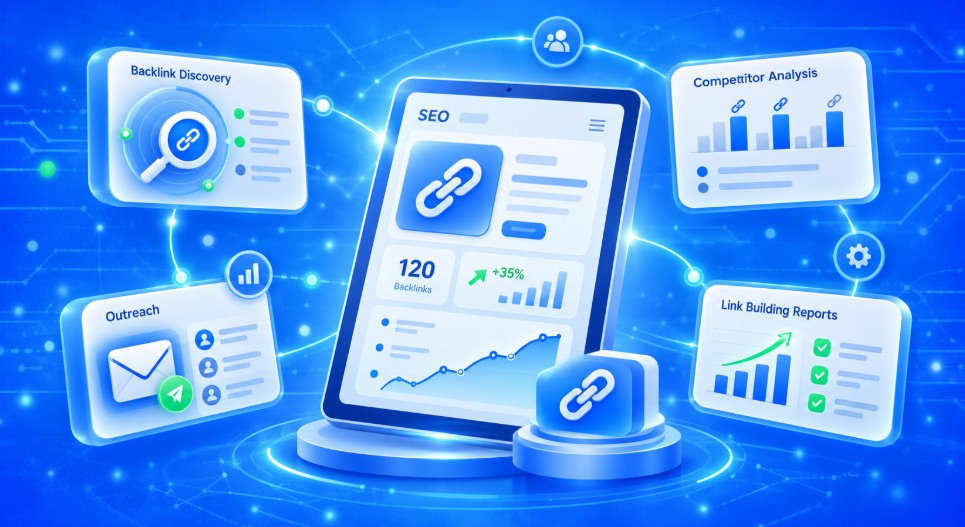

Finding websites that could link to you is easy.
Finding the right websites, identifying the correct person, contacting them without sounding automated, managing follow-ups and then checking whether the backlink stays live is considerably more difficult.
That is why professional link building rarely relies on one piece of software.
A serious campaign may require tools for several different jobs.
You may need to:
- Find websites linking to competitors
- Discover publishers in your niche
- Identify journalists and bloggers
- Find verified email addresses
- Manage outreach conversations
- Personalise email campaigns
- Track responses and follow-ups
- Check website relevance and authority
- Monitor backlinks after they go live
- Identify links that have disappeared
The best link building tools make these tasks considerably faster.
But software should not be confused with strategy.
Ahrefs can show that four competitors have links from the same publication. Hunter may help identify an email address. BuzzStream can manage the conversation.
None of those tools can guarantee that the publication is genuinely appropriate for your business or that an editor will actually want to link to you.
That part still requires judgement.
So, which are the best link building tools in 2026, and what should each one actually be used for?
What Are the Best Link Building Tools in 2026?
There is no single tool that performs every part of link building equally well.
Ahrefs and Semrush are strongest when the priority is competitor intelligence and link prospecting. BuzzStream and Pitchbox concentrate much more heavily on outreach management.
Hunter solves the contact-discovery problem, while Qwoted provides a different route to editorial coverage by connecting experts with journalists.
Here is the practical comparison.
| Link Building Tool | Best For | Main Role | Difficulty |
| Ahrefs | Competitor link prospecting | Finding backlink opportunities | Intermediate |
| Semrush | All-in-one SEO campaigns | Backlink gaps and wider SEO research | Intermediate |
| BuzzStream | Outreach management | CRM, prospecting and email outreach | Intermediate |
| Pitchbox | Agencies and larger teams | Scalable prospecting and outreach | Advanced |
| Respona | Managed link acquisition | Done-for-you outreach and placements | Easy |
| Hunter | Finding contact details | Email discovery and verification | Easy |
| Dibz | AI-assisted outreach | Prospecting and outreach automation | Easy–Intermediate |
| Qwoted | Digital PR | Journalist and expert opportunities | Easy |
| Linkody | Link monitoring | Tracking acquired and lost backlinks | Easy |
| SE Ranking | Value-focused SEO teams | Competitor gaps and backlink research | Easy–Intermediate |
The right choice depends on where your link-building process is currently breaking down.
If you cannot find good opportunities, you need better prospecting.
If you already have hundreds of prospects but nobody is replying, another backlink database probably will not solve the problem.
You may instead need better contact data, segmentation, personalisation or relationship management.
Top 10 Best Link Building Tools in 2026
1. Ahrefs
Ahrefs remains one of the most useful starting points for link builders because competitor backlink research can reveal opportunities that would otherwise be difficult to discover.
Its Link Intersect functionality is particularly valuable.
Instead of simply viewing thousands of backlinks pointing towards one competitor, you can find websites linking to several competitors while not currently linking to your own website.
Ahrefs currently allows Link Intersect research against multiple competing sites, while Content Explorer can also be used to discover pages, publishers and potential link prospects across its content database.
What Can Ahrefs Help You Find?
Ahrefs can be useful for:
- Competitor referring domains
- Individual competitor backlinks
- Link intersections
- Broken backlink opportunities
- Pages attracting large numbers of links
- Unlinked or potentially linkable mentions
- Relevant publishers
- Resource pages
- New and lost backlinks
- Anchor-text patterns
The most important part is knowing how to turn that information into a campaign.
Imagine four websites rank above your company for an important commercial search.
Run those competitors through Link Intersect.
Suppose you discover that three of them have links from the same industry publication.
That is considerably more interesting than discovering a random DA 70 website.
The publication has already demonstrated that it covers businesses or resources within your market.
Your next question becomes:
Why did those competitors receive links, and can we create a legitimate reason for the publication to mention us as well?
Perhaps they contributed expert commentary.
Perhaps the publication maintains a resource page.
Maybe each competitor was included in an industry comparison.
Or perhaps they published research that journalists repeatedly reference.
This is where a backlink database turns into link-building intelligence.
Best for: Competitor backlink research and prospect discovery.
Our view: Ahrefs is one of the strongest choices when your biggest challenge is identifying where good link opportunities exist.
2. Semrush
Semrush is another strong option, particularly when link building needs to operate alongside keyword research, technical SEO, competitor analysis and wider digital marketing activity.
Its Backlink Gap tool can compare competing websites and identify referring domains that link to competitors without linking to you.
Semrush currently allows comparison against up to five competing backlink profiles, while its broader backlink platform combines backlink analysis, auditing, gap research, media monitoring and newer PR functionality.
What Can You Do With Semrush?
Useful link-building applications include:
- Competitor backlink analysis
- Backlink gap research
- Referring-domain analysis
- Authority comparisons
- Anchor-text investigation
- New and lost backlink tracking
- Publisher research
- Media monitoring
- Digital PR prospecting
One reason Semrush can make sense for agencies is consolidation.
A team may already use the platform for keyword tracking, SEO reporting, competitor research and site audits.
Adding backlink prospecting into that workflow can be easier than maintaining several unrelated systems.
Its competitor-gap workflow is particularly useful for prioritisation.
Rather than exporting every domain linking to a competitor, look for domains that repeatedly link to several businesses operating within your sector.
Those domains often deserve manual investigation first.
Semrush is also increasingly connecting conventional backlink work with PR and AI-search visibility, including information around media sources cited by AI platforms.
That does not mean every website appearing inside an AI answer should suddenly become an outreach target.
But it illustrates how link building, digital PR, brand mentions and search visibility are becoming more closely connected.
Best for: Businesses wanting backlink research inside a broader SEO platform.
Our view: Semrush makes particular sense when your team already uses it for the rest of its SEO workflow.
3. BuzzStream
Finding 2,000 potential websites is not especially useful if your outreach process consists of putting everything into an uncontrolled spreadsheet.
That is where BuzzStream becomes considerably more valuable.
BuzzStream is essentially an outreach CRM built around digital PR and link building.
It can help teams research prospects, collect contact information, organise websites, manage relationships, send personalised outreach and monitor campaign progress.
Why Is an Outreach CRM Useful?
A professional campaign quickly becomes complicated.
You need to know:
- Who has already been contacted
- Which person works at each publication
- Whether somebody replied previously
- Which websites rejected the campaign
- Which editors requested more information
- Which relationships should be followed up
- Which publications have already linked to the client
- Which outreach template was used
- Whether a placement eventually went live
Managing this across hundreds or thousands of prospects becomes difficult inside an ordinary spreadsheet.
BuzzStream keeps much of that information connected.
It also supports email sequences, scheduled outreach, follow-ups and conversation tracking.
Where Does BuzzStream Work Best?
BuzzStream becomes particularly valuable when link building is being performed repeatedly.
A business running one small campaign may be comfortable managing outreach manually.
An SEO agency managing 15 clients cannot afford to lose every publisher conversation whenever a team member changes.
Relationship history becomes an asset.
That is particularly important with guest posting campaigns, where strong publisher relationships can be more valuable over time than continuously cold-emailing completely new websites.
Best for: Managing blogger outreach and publisher relationships.
Our view: BuzzStream is one of the strongest options for teams that already know how to find prospects but need a better system for managing them.
4. Pitchbox
Pitchbox targets professional link-building, outreach and digital PR teams that need to operate at considerably greater scale.
Its current platform combines prospecting, contact data, email outreach, workflow management and integrations with SEO platforms including Ahrefs, Semrush, Majestic and Moz.
That can eliminate a significant amount of spreadsheet work.
What Can Pitchbox Handle?
Pitchbox can help teams:
- Find prospects
- Research publishers
- Import opportunities from SEO tools
- Qualify prospects
- Discover contact information
- Personalise outreach
- Manage follow-ups
- Track campaigns
- Monitor team workflows
- Integrate outreach with wider systems
Its current prospecting system supports numerous prospect-discovery methods and can work from topics, keywords, competitor websites and imported datasets.
Pitchbox also puts significant emphasis on email deliverability, which matters when outreach volume increases.
Sending more emails does not automatically produce more backlinks.
If messages land in spam folders, reach irrelevant contacts or look mass-generated, scaling simply allows the campaign to fail faster.
Who Actually Needs Pitchbox?
Pitchbox makes the most sense for:
- Link-building agencies
- Digital PR agencies
- Larger SEO teams
- Enterprise campaigns
- Businesses handling high outreach volumes
- Teams managing numerous clients
A small business wanting to contact 20 relevant bloggers probably does not need an enterprise-style outreach platform.
A team processing thousands of opportunities each month may.
Best for: Professional agencies and high-volume outreach.
Our view: Pitchbox becomes more valuable as campaign complexity increases. For smaller operations, it may provide considerably more functionality than necessary.
5. Respona
Respona requires an important update in any 2026 comparison.
Older articles frequently describe Respona as a traditional DIY outreach platform.
That description is now outdated. Respona currently positions itself as a done-for-you link-building and digital PR platform.
The company says its team handles prospecting, contact discovery, outreach, follow-ups, negotiation, guest post placements, niche edits and relationship management after the customer chooses the pages they want promoted.
That changes where it belongs in a link-building technology stack.
Who Is Respona Best For Now?
Rather than asking:
Which tool should my outreach team use?
Respona may be more relevant when the question is:
Do we actually want to operate an outreach team ourselves?
Its present model can suit businesses that want software-assisted campaign visibility without personally managing every publisher conversation.
Its current Campaigns functionality is also designed to identify content appearing in conventional search results and AI-generated answers before potential placement opportunities are reviewed.
There is an important distinction, however.
Software automation and outsourced fulfilment should not eliminate quality control.
Any opportunity still needs to be evaluated for:
- Topical relevance
- Editorial quality
- Page quality
- Organic visibility
- Link context
- Anchor suitability
- Genuine usefulness
For existing-content placements, similar considerations apply to niche edit links.
Best for: Businesses wanting managed link acquisition rather than building an internal outreach operation.
Our view: Respona is interesting in 2026 precisely because its role has changed. Businesses comparing it with conventional outreach software should understand that difference before choosing a platform.
6. Hunter
Sometimes the biggest link-building problem is much simpler.
You found the perfect website.
You know exactly why it should care about your content.
But you cannot find the correct person to contact.
Hunter specialises in solving that part of the process.
Its current toolkit includes company discovery, Domain Search, Email Finder and Email Verifier functionality. The verification system is intended to help users check whether email addresses appear deliverable before outreach is sent.
Why Does Contact Quality Matter?
Generic emails such as:
info@website.com
or:
contact@publication.com
may work occasionally.
But targeted outreach is normally stronger.
Depending on the campaign, you might want:
- An editor
- A journalist
- A content manager
- A PR contact
- A partnership manager
- A website owner
- A specific article author
Finding the correct person makes personalisation considerably easier.
It can also reduce unnecessary email volume.
Sending 1,000 weak emails is not automatically better than sending 100 carefully selected messages to people who actually influence the content you want to appear within.
Email verification also matters.
Repeatedly sending messages to invalid addresses can increase bounce rates and create deliverability problems.
Best for: Finding and verifying professional email addresses.
Our view: Hunter is not a complete link-building platform, but it solves one of the most frustrating parts of outreach extremely well.
7. Dibz
Dibz is a specialist link prospecting tool built specifically to help SEOs find websites that may be suitable for backlink campaigns.
Rather than acting as a general SEO suite or cold-email platform, Dibz concentrates heavily on the research stage of link building.
It can help users find opportunities for guest posts, resource-page links, local citations, product reviews, content promotion and other common link-acquisition strategies.
What Can Dibz Help You Find?
Dibz can be used to search for:
- Guest posting opportunities
- Resource and links pages
- Relevant industry blogs
- Local citation opportunities
- Product review websites
- Content promotion prospects
- Influencers and bloggers
- Sponsorship opportunities
- Relevant forums
- Websites within specific niches or locations
One of its main advantages is that it reduces the amount of manual Google prospecting required.
A link builder could perform searches manually using operators such as:
intitle:"write for us"
or:
inurl:resources
But repeating this process across dozens of keywords and several clients quickly becomes time-consuming.
Dibz provides preset prospecting queries and filtering options designed specifically around different link-building strategies.
How Does Dibz Qualify Link Opportunities?
Finding websites is only the first stage.
A prospecting tool that produces thousands of irrelevant domains simply creates another filtering job.
Dibz therefore provides website metrics alongside a proprietary spam-filtering system intended to help users remove weaker prospects from larger datasets. Its platform says the filtering system considers multiple website signals when classifying potential opportunities.
That information can help prioritise a list, but it should not replace manual review.
Before approaching any website, check:
- Whether its content is genuinely relevant
- Whether it appears active
- Whether its pages are indexed
- Whether it attracts organic visibility
- Whether articles have editorial value
- Whether outbound links appear natural
- Whether your proposed backlink would help the reader
A software-generated quality score should therefore be treated as a filter rather than a final approval.
How Could You Use Dibz for Guest Post Prospecting?
Suppose an accountancy software company wants backlinks from UK finance and small-business publications.
The team could enter relevant topics and use Dibz’s guest-blogging prospecting functionality to discover websites that appear to accept external contributions.
The results could then be filtered and manually reviewed.
Instead of contacting every domain, the team might reduce several hundred initial prospects to 30 genuinely relevant publications.
Those 30 websites provide a much stronger starting point for outreach than a large unqualified database.
Dibz can also extract contact emails associated with discovered domains or work with an uploaded list of websites, helping connect prospect research with the next stage of outreach.
Where Does Dibz Fit Into a Link Building Stack?
Dibz is most useful at the prospecting stage.
A workflow could look like:
- Dibz finds relevant guest-post, resource-page and content-promotion opportunities.
- Ahrefs or Semrush provides additional backlink and competitor intelligence.
- Hunter or another contact tool verifies the appropriate contact where necessary.
- BuzzStream or Pitchbox manages larger outreach campaigns and publisher relationships.
- This is an important distinction because Dibz does not need to replace every other SEO platform.
- Its value comes from doing one specific job: finding potential websites to target for links.
Best for: Finding and qualifying link-building prospects.
Our view: Dibz is a useful specialist option for SEOs and agencies that spend significant time manually searching Google for guest posts, resource pages and other link opportunities. It is particularly relevant when prospect discovery is the bottleneck rather than backlink analysis or email management.
8. Qwoted
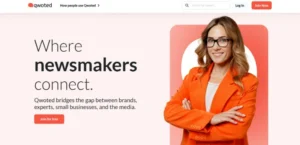
Not every backlink has to begin with:
“Hello, I was looking at your website and noticed…”
Digital PR provides a completely different link-acquisition route.
Qwoted connects journalists and other media professionals with experts and sources.
Journalists can publish calls asking for expert commentary, while businesses, specialists and PR professionals can respond when their expertise genuinely matches the request.
How Can Qwoted Help With Link Building?
Suppose a journalist is writing about:
- Business finance
- Cybersecurity
- Ecommerce
- Recruitment
- Property
- Technology
- Marketing
- Entrepreneurship
If someone within your company has credible expertise in that area, a useful response may result in a media mention.
Sometimes that mention includes a backlink.
Sometimes it does not.
That distinction matters.
Digital PR should not be treated as a guaranteed backlink marketplace.
The journalist controls the story, and the publication ultimately decides whether, where and how a source is referenced.
Qwoted says its platform provides direct access to journalists actively seeking expertise, making it useful for businesses trying to build genuine media relationships rather than sending completely unsolicited pitches.
What Makes a Good Journalist Pitch?
Be:
- Relevant
- Fast
- Specific
- Credible
- Quotable
- Helpful
Avoid turning every answer into an advertisement for the company.
Journalists need information that strengthens their story.
Best for: Expert commentary and digital PR opportunities.
Our view: Qwoted can produce opportunities that ordinary backlink databases cannot reveal because the relationship begins with a journalist who already needs a source.
9. Linkody
Most link-building articles concentrate entirely on getting the backlink.
But what happens six months later?
Articles get deleted.
Publishers redesign websites.
URLs change.
Links become nofollow.
Landing pages disappear.
Content gets rewritten.
That makes backlink monitoring part of link building rather than an entirely separate activity.
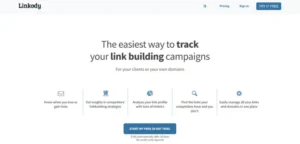
Linkody is designed specifically around tracking backlinks and changes to them.
Its current system can monitor new and lost links, backlink status, landing-page problems, anchor text and competitor links. Its Link Intersect report can also identify pages linking to competitors but not your site.
Linkody states that monitored link status is checked approximately every 24 hours.
Why Monitor Links You Already Built?
Suppose your business acquired an excellent editorial link last year.
The publisher later updates the article and accidentally removes it.
Without monitoring, nobody notices.
Finding that problem quickly provides an opportunity to investigate.
The same applies if the backlink remains live but your own destination page now returns a 404 error.
Acquiring new backlinks while existing strong links quietly break is inefficient.
For a deeper comparison of systems designed specifically for this job, Backlinks4U also covers backlink monitoring tools.
Best for: Tracking acquired links and identifying changes.
Our view: If your business is investing consistently in link acquisition, monitoring should become part of the campaign rather than something checked occasionally.
10. SE Ranking
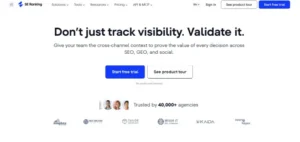
SE Ranking sits somewhere between specialist backlink software and the larger all-in-one SEO platforms.
Its current backlink toolkit includes a Backlink Checker, Backlink Gap Analyzer and Backlink Monitor.
The Backlink Gap Analyzer can identify domains and URLs linking to competitors but not the website being analysed, making it directly useful for prospect research.
Where Does SE Ranking Fit?
It can be useful for:
- Competitor backlink research
- Backlink gaps
- Referring-domain analysis
- Link monitoring
- Prospect qualification
- Anchor analysis
- Wider SEO work
This makes it particularly interesting for smaller agencies and in-house teams wanting to manage several SEO activities within one platform.
Large specialist teams may still prefer the depth of dedicated prospecting and outreach systems.
But not every company needs the largest possible backlink database or the most complicated outreach stack.
Sometimes usability and workflow matter more.
Best for: Small and medium-sized SEO teams wanting backlink research alongside wider SEO functionality.
Our view: SE Ranking provides a practical middle ground between basic backlink software and more complex enterprise platforms.
What Is the Difference Between a Backlink Checker and a Link Building Tool?
The two terms are frequently used as though they mean the same thing.
They do not.
A backlink checker primarily tells you about links that already exist.
A link building tool should help you do something with that information.
For example:
- Ahrefs discovers that an industry publication links to three competitors.
- Hunter helps identify the appropriate editor.
- BuzzStream stores the publication and relationship.
- Your outreach team creates a relevant reason for contact.
- Linkody later checks whether an acquired backlink remains live.
- Those tools serve completely different stages of one process.
This is why asking for the single “best link building tool” can sometimes be the wrong question.
The better question is:
Which part of the link-building workflow do we need to improve?
Which Link Building Features Actually Matter?
Software companies continually add dashboards, AI scoring systems and new metrics.
Not every feature deserves equal attention.
For most link-building campaigns, these capabilities matter more.
| Feature | Why It Matters |
| Competitor Link Gap | Reveals websites already linking within your market |
| Prospecting | Finds relevant publishers and webpages |
| Contact Discovery | Identifies the appropriate person to approach |
| Email Verification | Reduces outreach to invalid addresses |
| CRM | Keeps publisher relationships organised |
| Personalisation | Makes messages more relevant |
| Follow-Up Management | Prevents good opportunities being forgotten |
| Domain Metrics | Helps prioritise prospects |
| Topical Relevance | Determines whether a placement makes contextual sense |
| Backlink Monitoring | Identifies removed or changed links |
| Team Management | Prevents duplicated outreach |
| Reporting | Helps agencies measure completed campaigns |
The important point is that no single metric determines quality.
A prospect with a DR of 70 is not automatically better than one with a DR of 40.
You still need to inspect the website.
How Should You Evaluate Link Prospects Found by These Tools?
This is where manual review becomes essential.
Software may place 5,000 websites into an export.
That does not mean you have 5,000 good opportunities.
Start filtering.
Is the Website Actually Relevant?
The connection should make sense to a reader.
A financial publication referencing an accountancy platform makes sense.
A random entertainment blog linking to the same commercial finance page simply because somebody paid for space deserves far more scrutiny.
Does the Website Have Genuine Search Visibility?
Look at whether the site actually ranks.
Check:
- Organic keywords
- Ranking pages
- Traffic trends
- Publishing activity
- Brand searches
- Indexation
A respectable authority metric combined with almost no genuine visibility should trigger further investigation.
Is the Specific Page Good?
Do not evaluate only the domain.
Open the page where your backlink might appear.
Ask:
- Is the article genuinely useful?
- Is it indexed?
- Is the topic relevant?
- Does it have internal links?
- Does it appear editorially maintained?
- Is it overloaded with unrelated commercial links?
Page-level context matters.
Does the Website Publish Everything?
A website covering mortgages, casinos, CBD, plumbing, cryptocurrency, football, legal services and online pharmacies within the same generic blog may require additional inspection.
Wide editorial coverage is not automatically suspicious.
But obvious “publish anything for money” patterns should not be ignored.
Would the Link Help a Reader?
This remains one of the strongest tests.
Would somebody reading the article have a genuine reason to follow the link?
If yes, the placement has a natural contextual purpose.
If the only explanation is:
“The domain has DR 65.”
the opportunity probably needs more investigation.
That same relevance-first principle is central to Backlinks4U’s link-building approach.
How Can You Use Link Building Tools for Competitor Research?
Competitor backlink analysis is one of the strongest uses of tools such as Ahrefs, Semrush and SE Ranking.
But avoid simply copying every backlink.
Step 1: Identify Real SEO Competitors
Do not automatically use the companies your sales department considers competitors.
Search the keywords you actually want to rank for.
Record the websites consistently appearing above you.
Those are your organic-search competitors.
Step 2: Run a Link Gap Analysis
Compare several competitors rather than studying only one.
Look for referring domains linking to:
- Two competitors
- Three competitors
- Four competitors
Repeated overlap is particularly interesting.
Step 3: Investigate Why the Link Exists
Open the actual linking page.
Was the competitor included because of:
- Original research?
- A statistic?
- Expert commentary?
- Guest content?
- A product comparison?
- A resource page?
- An interview?
- A partnership?
- A directory?
- A niche edit?
- A journalist citation?
- A useful free tool?
The backlink tells you something about how that publisher links.
Step 4: Remove Opportunities You Do Not Want
Your competitors also have poor backlinks.
Do not reproduce spam simply because another website already has it.
Remove irrelevant domains, scraped pages, obvious link farms and opportunities that would make no sense for your audience.
Step 5: Create a Reason for the Publisher to Care
This is the part no backlink database can automate completely.
Perhaps you can provide:
- Better research
- New data
- Expert commentary
- An updated resource
- Original statistics
- A useful tool
- A stronger article
- A relevant case study
- A genuinely interesting company story
The link is the result.
The reason normally comes first.
Should You Automate Link Building Outreach?
Parts of it.
Automating repetitive administration can be extremely useful.
You can automate:
- Data collection
- Prospect enrichment
- Email verification
- Duplicate removal
- CRM updates
- Follow-up reminders
- Reporting
- Backlink monitoring
Be much more cautious about automating judgement and relationship building.
Sending 10,000 almost identical AI-generated emails does not suddenly become good outreach because the software inserts the editor’s first name.
A strong outreach email should demonstrate that you understand:
- Who the recipient is
- What they publish
- Why your suggestion is relevant
- What value you are providing
Automation should help a skilled link builder work faster.
It should not turn irrelevant outreach into industrial-scale irrelevant outreach.
How Is AI Changing Link Building Tools in 2026?
AI is becoming embedded throughout SEO software.
Platforms increasingly use it for:
- Prospect classification
- Contact research
- Email personalisation
- Campaign creation
- Opportunity prioritisation
- Competitor analysis
- Content summarisation
- Publisher research
- Media matching
That can substantially reduce manual administration.
It also creates a new problem.
If every business sends similar AI-generated outreach, generic emails become even easier for publishers to ignore.
The competitive advantage therefore moves towards better data, better ideas and better relationships.
AI can help explain what a prospect published.
It cannot automatically create a compelling reason that an editor should care about your company.
Do Link Building Tools Make Backlinks Safe?
No.
A piece of software does not make a backlink compliant with search-engine policies.
Google’s current spam policies explicitly identify creating links primarily to manipulate search rankings as link spam. They include buying or selling ranking links, automated link creation and certain optimised links within paid guest posts or advertorials among the examples.
Google also states that paid advertising or sponsorship links can be acceptable when appropriately qualified with rel=”nofollow” or rel=”sponsored”.
This distinction matters.
A tool can help you find websites.
It cannot determine your intention for you or turn a manipulative link scheme into legitimate editorial activity.
Businesses should therefore think beyond raw ranking metrics and concentrate on genuine relevance, editorial standards, useful content, PR value and the audience receiving the mention.
Should You Use One Link Building Tool or Several?
Professional link-building teams commonly use several because different platforms solve different problems.
A practical stack might look like this:
- Ahrefs or Semrush: For competitor backlink research and prospect discovery.
- Hunter: For identifying and checking email addresses.
- BuzzStream or Pitchbox: For managing outreach and publisher relationships.
- Qwoted: For journalist requests and digital PR opportunities.
- Linkody: For monitoring important links once they are live.
You do not need every platform.
Paying for six tools does not produce six times as many good backlinks.
Build the smallest stack that solves your actual workflow problems.
What Link Building Tool Is Best for a Small Business?
A small business rarely needs a complicated agency stack.
Start with competitor research.
Find several companies already performing well for your priority keywords and determine where their strongest relevant links originate.
SE Ranking or one of the larger SEO platforms can help with this research.
Hunter can then help with contact discovery where necessary.
The bigger priority should be creating something worth mentioning.
That could be:
- Useful local data
- Original research
- Specialist advice
- Statistics
- Industry commentary
- Practical resources
- Strong thought leadership
Twenty relevant prospects with a genuine reason to reference your business can be more valuable than 2,000 websites scraped into an outreach tool.
What Link Building Tools Are Best for Agencies?
Agencies have a different problem.
Scale.
Managing multiple clients means prospect lists, anchor plans, publisher conversations, approvals, placements and reports can quickly become difficult to control.
A more developed agency stack may include:
- Ahrefs or Semrush for research
- BuzzStream or Pitchbox for outreach management
- Hunter for contact discovery
- Linkody for placement monitoring
- Qwoted for PR opportunities
Teams that do not want to build a complete internal fulfilment operation may instead outsource parts of the process.
Backlinks4U’s white-label link building is designed for agencies that want publisher research, outreach, placements and reporting handled behind the scenes while retaining their own client relationships.
What Mistakes Should You Avoid With Link Building Software?
Tools create efficiency.
They can also create much larger mistakes much faster.
- Exporting Thousands of Prospects Without Filtering: More prospects do not automatically mean more opportunities. Relevance should come before scale.
- Sending the Same Outreach to Everybody: Changing the recipient’s first name is not genuine personalisation. Explain why the opportunity is specifically relevant.
- Chasing DR or DA Alone: Domain Rating and Domain Authority are third-party metrics. They are useful comparison signals, not Google ranking scores.
- Ignoring the Linking Page: Inspect the actual article or page where a backlink would appear. Domain-level metrics tell only part of the story.
- Copying Every Competitor Backlink: Competitors accumulate spam, irrelevant mentions and weak links too. Analyse. Do not blindly duplicate.
- Contacting the Wrong Person: An excellent pitch sent to an abandoned generic inbox may achieve nothing. Contact research matters.
- Treating AI Personalisation as Human Research: AI can assist research. Always check the result before sending. Incorrect references to an editor’s work are considerably worse than no personalisation at all.
- Forgetting Existing Publisher Relationships: Before cold-emailing a website, check whether somebody within your team already knows the editor. This is where an outreach CRM becomes valuable.
- Forgetting Lost Links: Link acquisition does not end when the placement appears. Monitor important backlinks.
- Expecting Software to Create the Strategy: The tool can find 400 publishers. It cannot automatically decide which 20 genuinely deserve your attention.
Which Link Building Tool Should You Choose?
If your priority is competitor backlink prospecting, start with Ahrefs.
If you want backlink research alongside a wider SEO suite, Semrush is a strong option.
If your biggest problem is managing outreach and publisher relationships, consider BuzzStream.
For larger agencies processing substantial prospect and outreach volumes, Pitchbox deserves consideration.
If you want a more managed rather than DIY process, look at the current Respona model.
For contact discovery and email verification, Hunter is particularly useful.
Smaller teams interested in combined AI-assisted prospecting and outreach may investigate Dibz.
For journalist requests and expert-comment opportunities, Qwoted provides a completely different route into link earning and PR.
For monitoring backlinks after they have been acquired, Linkody is a specialist option.
For a more value-focused combination of backlink analysis and wider SEO functionality, SE Ranking can make sense.
There is no universal winner.
The correct tool depends on the task immediately in front of you.
What Does Backlinks4U Look for Beyond Link Building Tools?
Tools provide information.
Human review determines what happens next.
When assessing a potential backlink opportunity, Backlinks4U looks beyond one authority metric and considers factors such as:
- Topical relevance
- Organic visibility
- Publishing quality
- Website history
- Linking-page relevance
- Anchor suitability
- Editorial context
- Existing outbound-link patterns
- Whether the placement makes sense to an actual reader
Technology can shorten the research process. It cannot replace those checks. The same applies during outreach. A list containing thousands of websites is only valuable after weak opportunities have been removed.
For companies that prefer editorial placements rather than operating the entire outreach process internally, guest posting campaigns can combine publisher research, content and placement management.
Existing relevant articles may also provide opportunities through carefully selected niche edit placements where the context genuinely matches the destination page.
The underlying principle remains the same. Find links that make sense rather than links that merely produce an attractive number inside an SEO report.
Final Thoughts
The best link building tools in 2026 do much more than show backlink counts.
They can identify publishers linking to competitors, discover contact information, manage outreach, find journalist requests, organise publisher relationships and monitor links after they are acquired.
Ahrefs and Semrush remain particularly strong for research.
BuzzStream and Pitchbox solve the operational challenges of outreach.
Hunter handles contact discovery.
Qwoted provides access to media opportunities.
Linkody helps protect the value of links you have already secured.
But none of them can press a button labelled “build good backlinks.”
That still requires strategy.
You need to decide which websites matter, why those publishers might care about your business, what value you can provide and whether the resulting link genuinely belongs within the content.
The most important thing to remember is this:
A link building tool can find the opportunity. It cannot create the reason you deserve the link.
The strongest campaigns therefore combine technology with competitor research, manual website checks, strong content, useful expertise and genuine publisher relationships.
That is how software becomes a link-building system rather than another collection of SEO dashboards.
Frequently Asked Questions About the Best Link Building Tools
What is the best link building tool?
Ahrefs is one of the strongest choices for competitor backlink research, while BuzzStream and Pitchbox are better suited to managing outreach. The best tool depends on which part of the link-building process you need to improve.
What is the best tool for finding backlink opportunities?
Ahrefs, Semrush and SE Ranking can all identify websites linking to competitors but not to your own domain. These opportunities should still be manually checked for relevance and quality.
What is the best link building outreach tool?
BuzzStream is particularly useful for relationship-based outreach and campaign management. Pitchbox is a stronger consideration for agencies and larger teams requiring more scalable workflows.
What is the best tool for finding outreach email addresses?
Hunter specialises in discovering and verifying professional email addresses and can be useful when you already know which websites or companies you want to approach.
Can AI tools build backlinks automatically?
AI can assist with prospecting, research, classification and email personalisation, but fully automated link acquisition can create poor-quality outreach and potentially problematic link patterns. Human review remains important.
What is the best tool for competitor backlink analysis?
Ahrefs and Semrush are among the strongest options. Their link-intersection and backlink-gap functionality can reveal referring domains that link to competing websites but not yours.
What is the best tool for digital PR link building?
Qwoted can be useful because it connects experts with journalists actively looking for sources. Coverage and backlinks are not guaranteed, however, because the journalist and publisher retain editorial control.
What is the best tool for monitoring backlinks?
Linkody is specifically designed around backlink tracking and can identify changes such as lost links, altered attributes and broken destination pages. Broader SEO platforms including Ahrefs, Semrush and SE Ranking also offer monitoring functionality.
Do I need several link building tools?
Not necessarily. Smaller businesses may only require one research platform plus an email or outreach tool. Agencies handling larger campaigns often combine separate prospecting, outreach, contact-discovery and monitoring systems.
Are link building tools safe for SEO?
The software itself is not what determines whether a backlink strategy is safe. Link acquisition should comply with search-engine policies and focus on genuine relevance, useful content, editorial value and appropriate treatment of sponsored or paid links.

[…] comparison. Businesses deciding which platform fits their workflow can also compare the available link building tools before building a larger prospecting […]
[…] performing this research regularly can use dedicated link building tools to compare competitors, discover referring domains and organise larger prospecting […]
[…] accelerate this research. Businesses building a larger workflow can compare the current best link building tools for competitor research, contact discovery, outreach management and […]