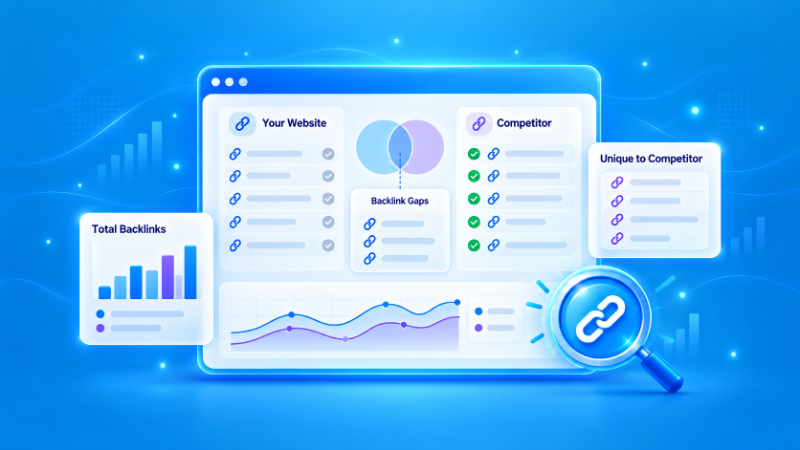

A competitor may rank above a business even when its content is not dramatically better. One of the reasons can be backlinks. Perhaps several respected industry publications link to the competitor.
Maybe it has been included in resource pages, comparison articles, directories, interviews and statistics round-ups that have never mentioned the competing business. In other cases, several websites ranking on page one may receive backlinks from the same group of authoritative domains.
That difference creates what SEO professionals commonly call a backlink gap. Learning how to do a backlink gap analysis helps turn that gap into practical link-building opportunities.
Rather than searching the internet randomly for websites that might provide a backlink, backlink gap analysis starts with evidence. It identifies websites that already link to competing businesses, investigates why those links exist, and determines whether similar opportunities are relevant and realistically obtainable.
The objective is not to copy every backlink a competitor has. The objective is to discover the right backlinks a business is currently missing.
What Is a Backlink Gap Analysis?
A backlink gap analysis is the process of comparing the backlink profile of a website against several competing websites to identify referring domains or individual pages that link to the competitors but do not currently link to the website being analysed.
For example, imagine four companies competing for similar commercial keywords. A particular industry publication links to three of those companies but has never linked to the fourth.
That publication represents a potential backlink gap. The opportunity becomes even more interesting if the publication has real organic visibility, covers the same industry, produces editorial content and has repeatedly referenced businesses operating in that market.
Backlink gap analysis therefore combines two separate activities:
- Data analysis identifies the missing links.
- Human evaluation determines whether those missing links are actually worth pursuing.
That distinction is extremely important.
A backlink tool may identify thousands of domains linking to competitors. Only a fraction may represent sensible opportunities.
Backlink Gap Analysis vs Competitor Backlink Analysis
The two terms are closely related but are not exactly the same. Competitor backlink analysis looks broadly at the backlinks pointing towards a competitor.
A backlink gap analysis compares several backlink profiles and specifically focuses on links competitors have that the analysed website does not.
| Analysis | Main Question | Typical Outcome |
| Competitor backlink analysis | Where is this competitor getting links? | Understanding a competitor’s backlink profile |
| Backlink gap analysis | Who links to competitors but not this website? | Identifying missing link opportunities |
| Link intersect analysis | Which domains link to several competitors? | Finding recurring publishers and high-priority prospects |
| Page-level backlink analysis | Which pages are attracting the links? | Understanding linkable content and link intent |
A professional campaign will normally use all four perspectives.
Why Is Backlink Gap Analysis Valuable?
Traditional backlink prospecting can become extremely broad. An SEO team might search for industry websites, manually inspect publications, search Google for contributors and spend hours deciding whether a domain has any realistic reason to link.
Backlink gap analysis narrows the field. If a publication already links to three direct competitors, there is evidence that it covers the industry and is willing to reference companies operating within it.
That does not guarantee another backlink. It does, however, make the publication considerably more interesting than an unrelated website discovered at random.
The analysis can also reveal patterns that would otherwise be difficult to notice. For example, a business may discover that competitors repeatedly earn links through original research rather than guest posts.
Another may discover that competitors appear in dozens of local business directories. An ecommerce company may find that competitors attract links primarily through product reviews and buying guides.
The gap therefore reveals more than potential domains. It can expose the link-building strategies working within a market.
How To Do a Backlink Gap Analysis Step by Step?
A useful backlink gap analysis requires considerably more than exporting a competitor’s backlinks into a spreadsheet.
The following process moves from competitor selection to link qualification and eventually into outreach.
Step 1: Decide Which Page or Keyword Cluster Is Being Analysed

Start with a clear objective.
Running a backlink comparison across entire domains can be useful for broad research, but it can also produce a huge amount of irrelevant data.
A more focused analysis might concentrate on a specific commercial page, product category, service or keyword cluster.
For example, a business selling accounting software could analyse competitors ranking for terms related to:
“accounting software for small businesses”
The competitors ranking for that search intent may be very different from those competing with the company for its brand name or informational blog content.
This distinction matters because backlink gaps are most useful when they support an actual SEO objective.
A sensible starting framework is:
| Element | Example |
| Target keyword | accounting software for small business |
| Target page | Small business accounting software landing page |
| Search market | Google UK |
| Competitors | Sites repeatedly ranking for that keyword cluster |
| Goal | Find relevant referring domains competitors have but the target site lacks |
Once the target is clear, competitor selection becomes much easier.
Step 2: Identify Real Organic Search Competitors
One of the most common backlink analysis mistakes is choosing the wrong competitors.
Business competitors and SEO competitors are not always the same.
Two companies may sell similar products but rarely compete against each other in organic search.
At the same time, a publisher, marketplace or comparison website may regularly outrank both companies despite having a completely different business model.
For backlink gap analysis, priority should generally be given to websites that consistently compete in the same search results.
Search the main target keywords and examine which domains repeatedly appear.
Ideally, select approximately three to five strong organic competitors with broadly comparable search intent.
Avoid choosing only one extremely large authority website.
If a small regional company compares itself exclusively with a multinational organisation receiving links from national media every day, the resulting gap may be technically accurate but commercially unrealistic.
Choose competitors whose backlink strategies can provide actionable information.
Step 3: Compare Referring Domains, Not Just Total Backlinks
Backlink counts can be misleading. One website may have 20,000 backlinks because a single domain links to it from thousands of pages.
Another may have 2,000 backlinks from 900 different relevant websites. For gap analysis, referring domains are usually more useful than raw backlink totals.
Suppose the comparison looks like this:
| Website | Backlinks | Referring Domains |
| Your website | 4,800 | 310 |
| Competitor A | 12,500 | 720 |
| Competitor B | 8,200 | 640 |
| Competitor C | 21,000 | 810 |
The important question is not simply why Competitor C has 16,200 more backlinks.
The more useful question is:
Which relevant domains link to those competitors but not to the analysed website?
Platforms such as Ahrefs, Semrush and SE Ranking can significantly accelerate this comparison. Businesses deciding which platform fits their workflow can also compare the available link building tools before building a larger prospecting system.
Step 4: Find Domains Linking to Multiple Competitors
This is where the analysis becomes particularly valuable. A website linking to only one competitor may represent an opportunity.
A website linking independently to three or four competitors is usually more interesting because repeated overlap can indicate strong topical relevance.
Imagine a report produces the following data:
| Referring Domain | Competitor A | Competitor B | Competitor C | Your Site |
| IndustryPublication.co.uk | Yes | Yes | Yes | No |
| BusinessDirectory.co.uk | Yes | Yes | No | No |
| RandomBlog.example | Yes | No | No | No |
| TradeAssociation.example | Yes | Yes | Yes | No |
The industry publication and trade association would normally deserve investigation before the random blog.
This does not mean every domain linking to three competitors is automatically high quality.
It simply gives the SEO team a strong prioritisation signal.
Step 5: Open the Actual Referring Pages
Never evaluate a backlink gap from domain-level metrics alone.
Open the exact page containing the competitor’s link.
This is where the real reason for the backlink normally becomes visible.
Perhaps the competitor appears inside an article discussing industry statistics.
Perhaps its founder contributed expert commentary.
Perhaps it supplied original research.
Maybe the backlink comes from a supplier page, directory listing, university resource, event partnership, review, podcast interview or editorial comparison.
Understanding why the backlink exists is essential because it reveals whether the opportunity can realistically be reproduced.
Consider two backlinks from the same high-authority newspaper.
One may be an editorial mention generated by original research.
Another may exist because the competitor sponsored a local event.
The domain is identical, but the acquisition strategy is completely different.
Step 6: Categorise Each Backlink Opportunity
At this stage, the analysis should move beyond “competitor has link, business does not”.
Every useful prospect should be assigned an opportunity type.
A practical structure might look like this:
| Opportunity Type | What Created the Competitor Link | Possible Response |
| Editorial mention | Journalist cited the company | Offer expert commentary or new data |
| Statistics article | Competitor supplied useful research | Publish stronger or updated statistics |
| Resource page | Competitor is listed as a useful resource | Suggest a genuinely relevant addition |
| Guest article | Competitor contributed content | Pitch an original article |
| Existing article | Link was added to relevant published content | Investigate a contextual niche edit |
| Directory | Competitor has a legitimate listing | Apply if the directory is relevant |
| Product review | Publisher reviewed the product | Offer a review opportunity where appropriate |
| Expert quote | Founder or employee was quoted | Build journalist and publisher relationships |
| Digital PR | Competitor generated newsworthy coverage | Develop a stronger PR angle |
| Partnership | Link comes from commercial collaboration | Investigate genuine partnership opportunities |
This step transforms an SEO export into a strategy.
Step 7: Evaluate Topical Relevance
Relevance should be one of the strongest filters in a backlink gap analysis.
A high authority score does not automatically make a website valuable.
Consider whether the referring website covers topics genuinely connected with the target business.
Then go one level deeper.
Evaluate the actual linking page.
A broad national publication may cover hundreds of subjects. A backlink from one of its pages discussing exactly the same industry can be far more contextually relevant than a link from an unrelated section.
The analysis should therefore consider both:
- Domain relevance: How closely the overall website relates to the business.
- Page relevance: How closely the exact linking page relates to the target page.
The strongest opportunities normally have both.
Step 8: Check Whether the Website Has Real Organic Visibility

Authority metrics such as Domain Rating, Domain Authority and Trust Flow can be useful comparative indicators.
They should not become the entire decision-making process.
These are third-party SEO metrics rather than Google scores.
A domain can display an impressive authority metric while having weak content, falling organic traffic, an unnatural outbound-link pattern or virtually no relevant readership.
A professional backlink gap analysis should therefore inspect organic visibility alongside authority.
Where data is available, examine whether the website ranks for legitimate keywords, whether its traffic trend looks reasonably stable, whether recently published pages are indexed and whether the site’s content has a coherent editorial focus.
A DR 70 website should not automatically outrank a DR 45 website in the prospect list.
The second website may be considerably more relevant.
Step 9: Inspect Outbound Link Quality
Competitor links should not be copied blindly.
Some competitors will have poor backlinks.
Others may have accumulated links from old campaigns, scraped websites, spam networks, low-quality directories or irrelevant domains.
Before adding a website to the outreach database, inspect its outbound links.
A publication that appears to link indiscriminately to casinos, loans, crypto schemes, supplements and unrelated commercial sites from the same articles deserves much closer scrutiny than a tightly edited specialist publication.
The objective of backlink gap analysis is not to achieve backlink-profile symmetry with competitors.
A business does not need every link its competitor has.
It needs the opportunities that strengthen its own backlink profile.
Step 10: Review the Linking Page’s Quality
Domain-level evaluation alone can hide weaknesses.
Inspect the exact page.
A useful referring page will normally have a clear editorial purpose, coherent content, genuine internal structure and a reason for linking externally.
The most important question is simple:
Would the backlink make sense if search engines did not exist?
If the answer is yes because the link helps readers find useful information, data, a business, a tool or a relevant resource, the opportunity is much easier to justify.
If the link would exist only to manipulate rankings, the opportunity deserves considerably more caution.
Step 11: Identify the Target Page for Each Opportunity
A backlink opportunity is incomplete until it has an appropriate destination page.
Too many outreach campaigns default to the homepage.
That may occasionally make sense, but it should not be automatic.
A technology publication discussing CRM implementation might naturally link to an in-depth CRM report rather than the homepage of a software company.
A local business directory may be more likely to link to a location page.
A journalist discussing a new dataset should link directly to the research.
Match the source page, context and user intent to the most suitable destination.
A prospecting spreadsheet should therefore contain a dedicated Target URL field before outreach begins.
Step 12: Analyse the Competitor’s Most Linked Pages
Backlink gap analysis should not stop at domain intersections.
Another powerful method is examining which competitor pages attract the most referring domains.
This reveals what the market naturally considers linkable.
Imagine competitors repeatedly earn links to:
- Industry statistics
- Free calculators
- Market reports
- Research studies
- Templates
- Tools
- Original surveys
- Data visualisations
That pattern tells the business something important.
Its backlink gap may not simply be an outreach gap.
It may be a content asset gap.
No amount of cold outreach can completely compensate for having nothing worth referencing.
If competitors have consistently produced stronger linkable assets, creating a superior asset may be more valuable than immediately sending outreach emails.
Step 13: Run a Page-Level Backlink Gap Analysis
Domain-level analysis asks:
“Which websites link to competitors but not this domain?”
Page-level analysis asks:
“Which pages link to competing content but not the equivalent page on this website?”
The second question can produce extremely targeted opportunities.
For example, suppose several articles comparing project management software all link to three competitor comparison pages.
A business with a stronger, more current comparison resource may have a clear outreach opportunity.
This is also where contextual link insertion can become relevant. When an existing article already covers the exact subject and another relevant resource could genuinely improve it, carefully selected niche edits may provide a more natural route than publishing an entirely new article.
Step 14: Build a Backlink Gap Spreadsheet
SEO tools are excellent for discovering the gap.
A structured spreadsheet is better for turning the gap into a campaign.
A detailed prospecting sheet can contain the following fields:
| Column | Purpose |
| Referring domain | Website being evaluated |
| Referring URL | Exact page containing competitor link |
| Competitors linked | Number and names of competitors receiving links |
| Domain authority metric | DR, DA or equivalent comparison metric |
| Estimated organic traffic | Indicates wider search visibility |
| Topical relevance | High, medium or low |
| Linking-page relevance | Relationship between source and target |
| Link type | Editorial, directory, guest post, resource, PR, review etc. |
| Link attribute | Follow, nofollow, sponsored or UGC where identifiable |
| Competitor anchor | How competitor is referenced |
| Target URL | Best page on the business website |
| Acquisition method | Outreach strategy |
| Contact | Relevant journalist, editor or website owner |
| Priority | High, medium or low |
| Status | Researching, approved, contacted, negotiating, won or rejected |
| Notes | Context required before outreach |
This spreadsheet eventually becomes the bridge between research and actual link acquisition.
How To Prioritise Backlink Gap Opportunities?
A spreadsheet containing 800 prospects is not necessarily more useful than one containing 80 carefully evaluated prospects.
Prioritisation is essential.
A practical scoring model could allocate points across five factors.
| Factor | Maximum Score |
| Topical relevance | 3 |
| Competitor overlap | 2 |
| Organic visibility | 2 |
| Linking-page quality and fit | 2 |
| Realistic acquisition path | 1 |
| Total | 10 |
A domain scoring 9/10 could enter the first outreach batch.
A prospect scoring 4/10 may remain in the database but receive much lower priority.
The scoring model does not need to be mathematically perfect.
Its purpose is to stop teams from chasing prospects simply because they have an attractive authority metric.
Example of a Backlink Gap Analysis
Imagine a fictional UK cybersecurity company called SecureExample wants to rank more strongly for commercial cybersecurity terms.
Three recurring organic competitors are identified.
The gap analysis reveals 1,200 domains linking to at least one competitor but not SecureExample.
That number is too large to use directly.
Filtering for domains linking to at least two competitors reduces the list to 320.
Removing irrelevant countries, obvious spam, unrelated industries and low-quality websites reduces it to 170.
Manual review identifies 90 websites with credible relevance.
Those 90 are then categorised.
Twenty are cybersecurity publications.
Fifteen are business technology websites.
Ten are industry directories.
Twelve are articles citing cybersecurity statistics.
Eight are podcast or interview opportunities.
Ten are partnership or association links.
The remaining prospects consist of various editorial opportunities.
At this point, the company does not have “1,200 missing backlinks”.
It has approximately 90 realistic opportunities, each requiring a different acquisition strategy.
That is what a useful backlink gap analysis should produce.
How To Turn the Analysis Into a Link-Building Campaign?

The backlink gap report is not the finished campaign.
It is the research layer.
The next task is deciding what value can be offered to each publisher.
For an article citing old statistics, the company could produce updated data.
For a resource page, it could offer a genuinely useful resource missing from the list.
For an industry publication, an experienced specialist might provide expert commentary.
For a website accepting external contributions, the company could pitch a topic tailored to the publication’s audience.
For an existing relevant article, a contextual link may be possible if there is a genuine reason for the editor to add the resource.
The outreach angle should follow the reason the competitor originally earned the link.
This is much stronger than sending the same message to every website in the spreadsheet.
Backlink Gap Analysis With Ahrefs
Ahrefs is commonly used for this type of competitor analysis because its backlink research tools allow SEO teams to compare domains, inspect referring websites and drill into the individual pages producing links.
A practical workflow is to identify organic competitors first, enter the analysed domain alongside competing websites, examine referring-domain intersections, and then investigate the actual source URLs.
The key is not to export everything and immediately begin outreach.
Use the platform to identify patterns, then manually review the opportunities.
The highest-value discoveries are often domains linking to several relevant competitors rather than a domain linking to one competitor once.
Backlink Gap Analysis With Semrush
Semrush can perform a similar job through its backlink comparison and gap functionality.
The broader workflow remains the same regardless of software.
Enter the domain being analysed, compare it with several genuine organic competitors, identify domains that link to competing sites, inspect the strength and relevance of those websites, and then determine how each competitor obtained the link.
The software changes.
The strategic questions do not.
Can a Backlink Gap Analysis Be Done Without Expensive SEO Software?
Yes, although it becomes considerably more time-consuming.
Manual research can include examining competitor brand mentions, searching industry publications, studying directories, reviewing journalists covering the sector and investigating pages that frequently reference competing businesses.
Free versions of backlink checkers may also provide limited information.
However, large-scale competitor intersections are where professional backlink databases save substantial time.
A small business may be able to investigate a handful of competitors manually.
An agency managing dozens of campaigns will normally require dedicated software.
Referring Domains Matter More Than Simple Link Volume
One mistake is turning the analysis into a race to match a competitor’s backlink number.
Suppose Competitor A has 50,000 backlinks and the analysed website has 8,000.
That does not necessarily mean 42,000 additional backlinks are required.
Many of those links could come from repeated sitewide placements or a small number of domains.
A much more useful question is whether competitors have substantially broader coverage from trusted, relevant referring domains.
Backlink gap analysis should focus on meaningful domain diversity, relevance and editorial quality rather than trying to reproduce raw numbers.
Look for Competitor Overlap Before Authority Metrics
Repeated competitor overlap is one of the strongest signals available during early research.
If a respected industry website links independently to four competing brands, there is already evidence that the publisher covers the market.
That prospect should often be investigated before an unrelated high-authority website that happens to have an impressive metric.
This is why a good workflow starts with relevance and overlap, then uses authority and traffic metrics as supporting information.
Do Not Automatically Reject Nofollow Links
A backlink gap report should distinguish link attributes, but it should not treat every nofollow link as worthless.
A respected publication may use nofollow attributes across external links as an editorial policy.
Such a mention can still put a brand in front of real readers, create referral traffic, increase brand discovery and potentially lead to secondary coverage.
Backlink decisions should therefore consider the wider value of the placement rather than treating every link as a simple follow-versus-nofollow calculation.
Do Not Copy a Competitor’s Anchor Text Strategy
Anchor-text information can provide useful context during analysis.
It should not become an instruction to reproduce the competitor’s anchors.
A healthy backlink profile can naturally contain brand names, URLs, product names, descriptive phrases and a variety of contextual anchors.
Trying to manufacture the same exact-match keyword anchor repeatedly can create an unnatural profile.
The surrounding content and reader context should normally determine the anchor rather than a spreadsheet quota.
Separate Obtainable Links From Unobtainable Links
Not every competitor backlink represents an actionable opportunity.
A competitor may have received a link because its founder attended a university, sponsored a charity, won a specific award, supplied technology to a partner or was involved in an event.
Those links may be perfectly legitimate but impossible for another company to reproduce.
Mark these separately.
Otherwise the campaign will waste time chasing links that have no realistic acquisition path.
A good backlink gap analysis answers two questions:
Is this link desirable?
Is there a credible way to earn or secure something similar?
Both need a positive answer before serious outreach begins:
Search for Patterns Across Competitor Links
Individual backlinks matter.
Patterns matter more.
If four competitors attract dozens of links from journalists because they publish proprietary industry data, that suggests an opportunity for original research.
If competing local companies have strong citation coverage while the analysed company has almost none, the issue may be local authority rather than editorial outreach.
If competitors repeatedly receive links from “best companies” articles, comparison coverage may deserve more attention.
If competitor founders appear frequently in interviews and expert commentary, digital PR and personal brand authority may be contributing to their backlink advantage.
The goal is to identify the system creating competitors’ links, not merely the URLs.
What Makes a High-Quality Backlink Gap Opportunity?
A strong prospect normally combines several characteristics.
The website is relevant to the business.
The exact referring page is contextually appropriate.
The domain has genuine search visibility or readership.
The competitor link appears editorially justified.
There is a realistic reason the publication could mention the analysed business.
The destination page would provide genuine value to readers.
The website does not show obvious signs of being created primarily to sell links.
No single third-party metric can replace these checks.
Backlink Gap Analysis and Content Gap Analysis Should Work Together
Some backlink gaps are actually content problems.
Imagine a competitor has 200 referring domains pointing towards an annual market report.
The analysed business has no equivalent research.
The first instinct might be to contact all 200 websites.
That misses the underlying reason those websites linked.
They needed the data.
A more effective strategy may be to create a better, newer or more specialised dataset first.
The company can then approach suitable publishers with something genuinely useful.
This is why backlink strategy and content strategy should rarely operate independently.
How Often Should a Backlink Gap Analysis Be Performed?
Competitive backlink profiles continually change.
Publishers add new articles.
Old links disappear.
Competitors launch research campaigns.
Companies receive press coverage.
New websites enter search results.
For active SEO campaigns, backlink gap research should therefore be revisited periodically rather than completed once and forgotten.
Quarterly analysis can be sufficient for many established businesses.
Highly competitive industries or active link-building campaigns may justify monthly competitor monitoring.
Once links have been acquired, dedicated backlink monitoring tools can also help identify new links, lost placements and competitor activity over time.
Common Backlink Gap Analysis Mistakes
Choosing Business Competitors Instead of Search Competitors
The company regarded internally as the biggest commercial rival may not be the site competing for the same organic keywords.
Use search-result overlap to guide competitor selection.
Comparing With Only One Competitor
One competitor’s backlink profile may contain unusual partnerships or strategies.
Comparing multiple competitors makes recurring patterns easier to identify.
Exporting Thousands of Links Without Reviewing Them
A large spreadsheet is not a strategy.
Every serious prospect should eventually receive some level of manual evaluation.
Treating DR or DA as Google Metrics
Authority scores are useful third-party comparison metrics.
They should never become the sole definition of link quality.
Ignoring the Actual Referring Page
A good domain can contain poor pages, while a broad website can contain highly relevant specialist pages.
Analyse page context as well as domain metrics.
Assuming Every Competitor Link Should Be Replicated
Competitors accumulate weak backlinks too.
A gap can be intentionally left open if the missing link offers little value.
Sending Outreach Before Understanding the Link
Before contacting the publisher, determine why the competitor was linked.
That information should shape the pitch.
Focusing Only on Dofollow Links
A valuable editorial mention can have commercial and brand value even where the link attribute does not directly match the team’s preferred format.
Ignoring the Website’s Own Content
Sometimes the problem is not a lack of outreach.
The website simply does not have a page that deserves the backlink.
Backlink Gap Analysis Checklist
Before turning the report into outreach, the campaign should be able to answer the following:
| Question | Completed? |
| Have genuine organic competitors been identified? | Yes/No |
| Are several competitors being compared rather than one? | Yes/No |
| Have referring domains been analysed separately from backlink totals? | Yes/No |
| Have domains linking to multiple competitors been prioritised? | Yes/No |
| Has each important referring page been manually reviewed? | Yes/No |
| Has topical relevance been assessed? | Yes/No |
| Has organic visibility been checked? | Yes/No |
| Have poor or irrelevant websites been removed? | Yes/No |
| Has the reason for each competitor link been identified? | Yes/No |
| Has each prospect been assigned an acquisition method? | Yes/No |
| Has the best target URL been selected? | Yes/No |
| Have opportunities been prioritised before outreach? | Yes/No |
If several answers are still “No”, the campaign probably needs more research before emails are sent.
Is Backlink Gap Analysis Worth Doing?
Yes, particularly in competitive search markets.
The main advantage is efficiency.
Instead of beginning link prospecting with an empty spreadsheet, a business can start with websites already demonstrating an interest in the industry or its competitors.
However, backlink gap analysis should not be treated as an automatic copying exercise.
Competitor links provide clues.
The SEO team still needs to evaluate relevance, quality, context, acquisition difficulty and the value its own website can offer.
The strongest campaigns use competitor data as a starting point and then build something better.
Final Thoughts
Understanding how to do a backlink gap analysis can make link building considerably more focused.
The process begins by identifying genuine organic competitors, comparing referring domains and discovering websites that link to competitors but not the target website.
But that is only the first stage.
The real value comes from investigating why those links exist.
A competitor may earn links because it publishes stronger research, appears in more industry resources, contributes expert commentary, maintains relationships with publishers or produces content that people genuinely want to reference.
A strong backlink gap analysis uncovers those patterns.
It then filters the raw data according to topical relevance, website quality, page context, organic visibility and realistic acquisition potential before turning the best opportunities into a prioritised outreach campaign.
The goal is not to obtain every backlink competitors have.
It is to identify the missing links that make strategic sense, understand why competitors earned them and create a stronger reason for relevant publishers to link to the business in the future.
Frequently Asked Questions
What is a backlink gap?
A backlink gap is the difference between the referring domains linking to competing websites and those linking to a particular website. In practical SEO work, the term normally refers to relevant domains that link to one or more competitors but not the site being analysed.
What is a backlink gap analysis?
A backlink gap analysis compares backlink profiles to identify potentially valuable domains and pages that link to competitors but not the analysed website. The opportunities are then reviewed for relevance, quality and acquisition potential.
How many competitors should be used for backlink gap analysis?
Approximately three to five relevant organic competitors is a useful starting point for many campaigns. Using several competitors makes it easier to identify domains repeatedly linking across the market rather than websites connected to only one company.
Should a business copy every competitor backlink?
No. Competitors can have irrelevant, low-quality or unobtainable backlinks. Each opportunity should be reviewed independently before it enters an outreach campaign.
What is the difference between a backlink and a referring domain?
A backlink is an individual link from another page. A referring domain is the website providing one or more backlinks. One referring domain can therefore generate hundreds or thousands of individual backlinks.
Which metrics should be checked during backlink gap analysis?
Useful information includes referring-domain strength, estimated organic traffic, topical relevance, linking-page relevance, competitor overlap, link attributes, anchor text, source-page quality and the realistic likelihood of acquiring a link.
Is Domain Rating enough to judge a backlink?
No. Domain Rating and similar third-party authority metrics are useful for comparison, but they should be considered alongside relevance, organic visibility, editorial quality and the context of the actual referring page.
Are backlinks from domains linking to several competitors better?
Not automatically, but they deserve attention. A domain independently linking to several genuine competitors can indicate that the publication is highly relevant to the industry and familiar with covering businesses operating within it.
Can backlink gap analysis help with digital PR?
Yes. Competitor backlink patterns can reveal journalists, publications, studies, statistics pages and news formats generating coverage within an industry. Those findings can inform future digital PR campaigns.
Can backlink gap analysis reveal content ideas?
Yes. Examining competitors’ most linked pages often reveals the types of assets publishers naturally reference, including original research, statistics, calculators, reports, tools and templates.
How often should backlink gap analysis be carried out?
For many businesses, quarterly analysis is sufficient. More competitive sectors or active SEO campaigns may benefit from monthly monitoring because competitor backlink profiles can change frequently.
What should happen after a backlink gap analysis?
The strongest opportunities should be prioritised, matched to relevant destination pages, assigned an acquisition strategy and transferred into an outreach workflow. Results should then be monitored so the next analysis can focus on the remaining gaps and new competitor activity.
