
Backlinks are an important part of search engine optimisation, but not every link pointing to your website is valuable.
Some backlinks come from relevant publications and genuine editorial recommendations, while others originate from automated networks, spam directories, unrelated websites or manipulative link-building campaigns.
The challenge is knowing which links genuinely deserve attention.
A website might have 10,000 backlinks and a healthy search presence, while another has just 500 links but faces problems because many were deliberately created to manipulate rankings.
To find toxic backlinks, start with Google Search Console, export your backlink profile, identify suspicious referring domains, examine anchor text and linking-page quality, and manually review the links before deciding whether any action is necessary.
Not every suspicious backlink needs removing. Google already has systems designed to discount many unnatural links, and automatically disavowing every link flagged by an SEO tool can create more problems than it solves.
In our assessment of backlink evaluation methods, the most important distinction is between links that simply look weak and links that provide credible evidence of deliberate ranking manipulation.
This article explains how to identify toxic backlinks, evaluate their risk, use professional SEO tools and protect your website’s long-term organic visibility.
What Are Toxic Backlinks in SEO?
Toxic backlinks are external links that may be associated with spam, artificial link creation or practices intended to manipulate search engine rankings.
However, “toxic backlink” is an industry term, not a formal Google classification. Google publishes link-spam policies, while third-party SEO platforms use their own scoring systems to identify potentially suspicious links.
For example, a backlink from an unfamiliar website with little organic traffic might receive a poor score in an SEO tool. That does not automatically mean Google considers the link harmful.
The underlying reason for the backlink matters considerably more.
A naturally earned link from a small business blog may be legitimate even if the referring domain has a low Domain Rating.
Conversely, links placed across numerous unrelated websites using identical commercial anchor text could raise serious concerns if they form part of a deliberate link scheme.
What Is the Difference Between Good, Bad and Toxic Backlinks?
| Backlink type | Characteristics | Recommended response |
| High-quality editorial backlink | Relevant content, genuine recommendation, useful source | Keep and monitor |
| Low-authority backlink | Small website, limited traffic, but legitimate content | Usually keep |
| Irrelevant backlink | Weak topical relationship with the destination | Investigate context |
| Spam-generated backlink | Automatically created or scraped without your involvement | Usually monitor or ignore |
| Manipulative backlink | Deliberately built primarily to influence search rankings | Investigate and correct |
| Paid followed backlink | Payment made for ranking credit without appropriate qualification | Correct link attributes or remove |
| Artificial network backlink | Coordinated linking intended to manipulate rankings | High-priority review |
An important distinction is that a backlink can have little or no SEO value without being dangerous.
From a commercial perspective, businesses should focus on identifying genuine risks rather than spending money removing every unfamiliar link.
How Can You Identify Toxic Backlinks on Your Website?
We recommend examining multiple signals together instead of relying on a single metric.
1. Links From Irrelevant Websites
A backlink from a website covering an unrelated subject may deserve investigation, particularly when the surrounding content makes no sense.
For example, an accountancy firm receiving an editorial reference from a business publication is understandable.
However, the same firm appearing in hundreds of unrelated articles with identical money-related anchors presents a different pattern.
Relevance does not mean every backlink must originate from the same industry. News websites, charities, universities, regional publications and business directories naturally cover varied subjects.
The concern arises when there is no convincing editorial reason for the link to exist.
2. Backlinks From Automated Networks
Some backlinks are generated through automated tools that publish content or links across large numbers of websites.
Potential warning signs include:
- Repeated articles containing the same outgoing links.
- Thousands of links appearing within a short period.
- Identical commercial anchor text across unrelated domains.
- Automatically generated profile pages or forum comments.
- Linking pages containing very little original information.
- Multiple suspicious websites sharing coordinated templates and linking behaviour.
Automation alone does not establish that a website is penalised. The key issue is whether links were deliberately created to manipulate rankings.
3. Links From Suspicious Directories
Legitimate business directories can provide useful visibility, contact information and referral traffic.
A relevant industry directory or local business listing should not be considered harmful simply because it is a directory.
Problems emerge when directory websites exist primarily to publish vast numbers of keyword-rich outbound links without meaningful editorial review.
Before marking a directory backlink as harmful, examine whether the website serves genuine users and whether the listing has a legitimate business purpose.
4. Links With Over-Optimised Anchor Text
Anchor text is the clickable wording used in a hyperlink.
Natural backlink profiles often contain a combination of:
- Brand names
- Website URLs
- Article titles
- Descriptive phrases
- Partial keyword references
- Generic wording
However, repeatedly creating backlinks with identical exact-match commercial keywords can indicate manipulation.
A company targeting “best accountant London” should be cautious if a former SEO provider placed that exact phrase across dozens of unrelated websites.
There is no universal Google-approved anchor text percentage. The relevant question is whether the pattern arose naturally or through an artificial campaign.
5. Links From Artificial Blog Networks
A group of websites may be created or operated primarily to generate backlinks to selected commercial websites.
Potential warning signs include thin articles, repetitive outbound linking, fabricated editorial identities, unnatural anchor placement and a lack of genuine readership.
Shared hosting, similar themes or common ownership alone are not proof of a link scheme. Many legitimate publishers operate several websites.
What matters is the purpose and pattern of the linking activity.
6. Links From Compromised or Spam-Infected Pages
Sometimes legitimate websites are hacked, and spam links are inserted into their content.
A link appearing inside injected gambling, pharmaceutical or unrelated promotional text should be investigated.
If the page is genuinely compromised, the appropriate initial response may be to contact the website owner and request removal.
7. Sitewide Footer and Sidebar Links
A single link in a website footer may appear on hundreds or thousands of pages.
This can inflate a site’s reported backlink count without generating equivalent numbers of independent referring domains.
Sitewide links are not automatically violations. Genuine attribution, navigation and business relationships can explain them.
However, keyword-rich sitewide links installed specifically to manipulate search rankings warrant scrutiny.
This is why referring-domain analysis is often more useful than looking only at total backlink volume.
How Do You Find Toxic Backlinks Using Google Search Console?
Google Search Console is one of the most useful starting points because it provides backlink information directly from Google’s systems.
It is free for verified website owners.
However, the Links report is a sample of discovered links, not a complete, real-time backlink index. It can include links that have already disappeared and does not report whether individual links carry a nofollow attribute.
Step 1: Open the Links Report
- Sign in to Google Search Console.
- Select the verified website property.
- Open Links from the navigation menu.
- Locate the External links section.
- Review Top linked pages, Top linking sites and Top linking text.
Start by checking which external domains link to your website most frequently.
A domain generating hundreds of links is not necessarily suspicious, but it deserves examination if those links appear unnatural.
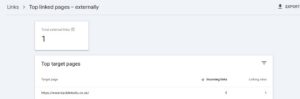
Google Search Console Links report showing external linking websites, top linked pages and backlink data.
Step 2: Export Your Backlink Data
Inside the Links report, use the relevant export options to download referring-domain and external-link information.
You can also export a list of recently discovered links.
Open the spreadsheet and organise the data around:
| Data field | Why it matters |
| Referring domain | Identifies the website providing the link |
| Source URL | Shows the page containing the backlink |
| Target URL | Shows which page on your website receives the link |
| Anchor text | Helps identify unnatural keyword repetition |
| Link discovery date | Helps investigate sudden backlink changes |
| Link attribute | Shows whether the link is followed or qualified, where available |
| Review status | Records whether the link is legitimate or requires investigation |
Search Console exports may need supplementing with additional backlink tools to obtain all these fields.
Our preferred approach is to consolidate links into a master spreadsheet, group them by referring domain and retain individual source URLs for further investigation.
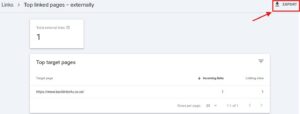
Exporting external backlinks from Google Search Console for manual analysis in Excel or Google Sheets.
Step 3: Examine Anchor Text
Open Top linking text and look for unusual patterns.
For example, if a UK business receives numerous backlinks using unrelated commercial keywords, investigate where those links originated.
Do not apply an arbitrary rule such as treating every anchor-text share above 20% or 30% as harmful.
A recognisable brand can naturally receive many branded links, while a particular article may receive repeated descriptive anchors because publishers reference its title.
The context, acquisition history and overall pattern are more important than a fixed percentage.
Step 4: Check for Manual Actions
Navigate to:
Security & Manual Actions → Manual actions
If Google reports no issues, that is reassuring, although it does not guarantee every backlink is valuable.
If Google has issued an unnatural-links manual action, follow the instructions in the report and investigate the affected link patterns carefully.
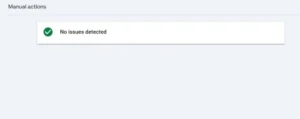
Checking Google Search Console for manual actions related to unnatural backlinks.
How Can You Find Toxic Backlinks Using Semrush and Ahrefs?
Professional SEO tools provide additional information that helps identify unusual backlink patterns, compare referring domains and investigate the history of a link profile.
Our assessment is that these platforms are most valuable when their findings are combined with human review.
Using Semrush Backlink Audit
Semrush offers a dedicated Backlink Audit tool that evaluates backlinks using proprietary risk indicators.
To begin:
- Create or open a project for your website.
- Launch the Backlink Audit tool.
- Configure the audit and run the analysis.
- Open the Audit tab.
- Sort or filter backlinks by Toxicity Score.
- Review the individual toxic markers.
- Inspect suspicious referring pages before taking action.
Semrush uses a toxicity scale from 0 to 100.
A higher score indicates that its system has detected more concerning signals. It does not mean there is an equivalent percentage probability of receiving a Google penalty.
A score of 85 should prompt investigation, not automatic removal.
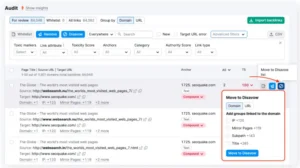
Semrush Backlink Audit displaying suspicious referring domains, toxicity scores and individual backlink risk markers.
Using Ahrefs for Suspicious Backlink Analysis
Ahrefs takes a different approach.
It does not provide a dedicated universal spam score. Instead, its backlink reports allow users to investigate individual link characteristics and filter large datasets.
Useful information includes:
- Domain Rating
- Referring domains
- Backlink source pages
- Organic traffic estimates
- Anchor text
- New and lost backlinks
- Link attributes
- Outgoing-link patterns
For example, a high-DR website with very little relevant content and hundreds of unrelated outbound links should not automatically be considered a good link source.
Likewise, a low-DR website publishing an authentic industry article may still provide a valuable editorial reference.
For a wider comparison of backlink research platforms, our review of backlink monitoring tools explains the differences between specialist tools and their monitoring capabilities.
Which Tools Are Most Useful for Finding Toxic Backlinks?
| Tool | Main advantage | Limitation | Our suitability rating |
| Google Search Console | Free first-party backlink data and manual-action checks | Limited backlink sample and quality filters | 95% |
| Semrush | Dedicated toxicity indicators and audit workflow | Proprietary scores require validation | 93% |
| Ahrefs | Detailed backlink history, anchors and referring-domain research | No universal toxic-link score | 92% |
| Majestic | Trust Flow and topical link analysis | Requires interpretation of specialist metrics | 84% |
| Moz | Accessible Spam Score and authority comparisons | Scores are not Google penalty indicators | 82% |
| SE Ranking | Backlink analysis within a broader SEO platform | Depth and features vary by plan | 81% |
These percentages are our editorial suitability assessments based on the tools’ relevant capabilities and workflow. They are not laboratory-tested accuracy rates or claims about the percentage of toxic links correctly detected.
Businesses can also compare broader link-building tools before selecting software for recurring audits.
How Should You Evaluate Whether a Backlink Is Actually Toxic?
This is where many backlink audits become unnecessarily aggressive.
A software tool can identify questionable characteristics, but it cannot always establish why a link was created.
Our recommended approach is to combine five review criteria.
| Evaluation factor | Maximum contribution to our review-priority score |
| Evidence of intentional ranking manipulation | 30% |
| Lack of genuine editorial context | 25% |
| Manipulative anchor text or placement | 20% |
| Artificial website or network characteristics | 15% |
| Repeated suspicious acquisition pattern | 10% |
| Total | 100% |
These weights provide a structured editorial checklist. They are not Google’s ranking factors or a scientifically validated risk-prediction model.
The more evidence of deliberate manipulation, the more urgently a backlink deserves review.
Our Illustrative Toxic Backlink Review Ratings
| Backlink scenario | Review-priority rating | Recommended action |
| Large group of deliberately purchased followed links with keyword-rich anchors | 95% | Urgent investigation and correction |
| Automated network links acquired through a previous SEO campaign | 90% | Review campaign records and remediate |
| Coordinated private network created to manipulate rankings | 85% | Investigate link scheme and removal options |
| Unrelated guest-post links with repeated commercial anchors | 75% | Manual review and correction where appropriate |
| Low-quality directory placement with unclear acquisition history | 55% | Investigate before acting |
| Unsolicited scraper backlink | 15% | Usually monitor or ignore |
| Genuine niche publication with a naturally placed editorial link | 5% | Keep |
Ratings are hypothetical examples of investigation priority, not observed penalty rates. No percentage alone determines whether a backlink should be disavowed.
This approach prevents an important mistake: treating every backlink from a low-traffic or low-authority website as harmful.
Fernando Raymond, Link Building Expert, has emphasised editorial selectivity in his published commentary on niche websites:
A blog that publishes anything for anyone loses its value within a year.
That principle is particularly relevant when evaluating websites that sell or publish large numbers of unrelated guest posts.
An authentic publication should have an identifiable audience, meaningful content standards and a clear reason for referencing a particular website.
The strongest backlink assessments look beyond domain authority and examine whether the link would make sense to a real reader.
Can Toxic Backlinks Affect Google Rankings and Business Revenue?
Yes, manipulative backlinks can create ranking risks, particularly where a website has participated in link schemes that violate Google’s policies.
However, it is important to distinguish between three different situations.
First, Google may simply ignore or neutralise links it considers unnatural. This can mean the backlinks contribute little or no ranking value.
Second, a website may lose rankings when artificial ranking benefits are removed. In this situation, the lost benefit does not necessarily return after the offending links are cleaned up.
Third, Google may issue a manual action for unnatural links. This requires the site owner to investigate and address the violation.
A ranking decline does not automatically prove that backlinks caused it.
Content quality, technical SEO problems, changed search intent, competition and search algorithm updates may also influence performance.
What Is the Financial Impact of Losing Organic Traffic?
Consider a hypothetical UK business with the following performance:
| Business metric | Before a traffic decline | After a hypothetical 25% decline |
| Monthly organic visits | 20,000 | 15,000 |
| Enquiry conversion rate | 3% | 3% |
| Monthly enquiries | 600 | 450 |
| Enquiry-to-customer conversion | 20% | 20% |
| New customers | 120 | 90 |
| Average customer revenue | £250 | £250 |
| Revenue attributed to these customers | £30,000 | £22,500 |
Under these assumptions, the difference is £7,500 in monthly revenue.
This is an illustrative commercial model, not evidence that toxic backlinks cause a 25% traffic decline.
The calculation demonstrates why businesses should investigate serious SEO problems carefully rather than responding impulsively to a software warning.
Before attributing a decline to backlinks, compare search performance, manual-action reports, technical changes and the dates of major search updates.
How Can You Remove Toxic Backlinks Safely?
Once a backlink has been manually reviewed, choose the least disruptive action appropriate to the situation.
Not all questionable links require removal.
Step 1: Separate Links Into Three Categories
| Classification | Description | Action |
| Keep | Legitimate editorial links or harmless low-quality links | No removal needed |
| Investigate | Suspicious patterns requiring more evidence | Examine provenance and context |
| Correct or remove | Confirmed manipulative links, especially those created through your own campaigns | Seek correction or removal |
Maintain records explaining why each domain was classified.
This is particularly important when auditing websites that have changed SEO agencies or ownership.
Step 2: Contact the Linking Website
Where you have identified a genuinely manipulative backlink, contact the website owner.
Explain which URL contains the link and request an appropriate correction.
Depending on the circumstances, this could involve:
- Removing the link completely.
- Changing the anchor text where the placement remains editorially legitimate.
- Adding rel=”sponsored” to an advertising or paid placement.
- Adding rel=”nofollow” where appropriate.
- Correcting an unrelated or misleading reference.
Changing an anchor does not automatically make a manipulative link compliant. The link must still have a legitimate purpose and meet Google’s policies.
Outreach requires careful communication and accurate placement records.
As I previously written said:
Trying more shortcuts and irrelevant bunch of backlinks will harm your SEO.
That warning applies particularly to campaigns prioritising backlink volume without examining the websites involved.
Effective outreach link building relies on appropriate publishers, useful references and transparent communication rather than sending identical placement requests to thousands of websites.
Step 3: Document Every Removal Attempt
For serious link-cleanup work, maintain a record of:
- Referring domain and source URL
- Destination page
- Suspected policy violation
- Date the issue was identified
- Website-owner contact details
- Removal or correction request dates
- Publisher responses
- Final review outcome
Do not pay suspicious operators simply because they demand a fee to remove a backlink.
If a site owner does not respond, record the attempt and assess whether the circumstances meet Google’s conditions for disavowal.
When Should You Disavow Toxic Backlinks?
Google’s Disavow Links tool tells Google to disregard specified backlinks when assessing your website.
It is an advanced feature, not a routine backlink-cleaning tool.
Google advises using it only when both of the following apply:
- A considerable number of spammy, artificial or low-quality links point to your website.
- Those links have caused a manual action or are likely to cause one.
For most websites, Google can assess which links to trust without additional instructions.
Our recommendation is to reserve disavowal for serious, documented cases rather than regularly uploading lists of links with low third-party scores.
How Do You Create a Disavow File?
If disavowal is justified, begin by reviewing the backlinks you have already investigated.
Create a plain-text file containing the specific URLs or domains that you want Google to disregard.
For example:
domain:unwanted-network.example
https://spam-directory.example/irrelevant-page.html
Use the domain: prefix to disavow a whole domain. Use a complete URL to disavow an individual page.
The file must be a .txt file encoded in UTF-8 or 7-bit ASCII.
Google permits up to 100,000 lines and a maximum file size of 2 MB. You cannot disavow an entire URL subdirectory with a single directory-level instruction.
Before submission, carefully verify that the file does not include legitimate publishers or valuable editorial backlinks.
How Do You Submit the Disavow File?
- Open the Google Disavow Links tool.
- Select the correct verified URL-prefix property.
- Review any existing disavow list.
- Prepare a complete replacement file if changes are required.
- Upload the .txt file.
- Check the confirmation and any reported errors.
- Retain the final file and submission date.
The tool does not support selecting a Domain property directly.
Important: Uploading a new file replaces the existing disavow list for the selected property. Always preserve previous valid entries when updating an existing list.
Disavowed links can remain visible in the Links report, and Google may take several weeks to process the changes as it recrawls pages.
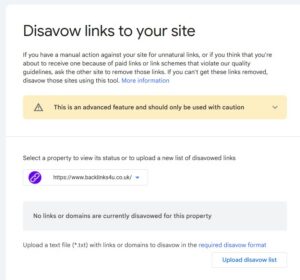
Google’s official Disavow Links tool, showing where a verified website owner can upload a disavow file when genuinely necessary.
If a manual action has been issued, complete the necessary remediation and submit a reconsideration request through Search Console when appropriate.
There is no guarantee that rankings will immediately recover after disavowal, particularly where Google has already discounted artificial ranking signals.
Can You Prevent Toxic Backlinks Before They Become a Problem?
Prevention is generally more efficient than repeatedly cleaning up aggressive link-building campaigns.
A sustainable strategy begins with understanding why a publication should genuinely reference your website.
Evaluate Publishers Before Building Links
Before pursuing an opportunity, review the publisher’s content, audience, reputation and existing outbound links.
The aim is to identify genuine editorial value.
For example, when examining potential guest posting opportunities, consider whether the proposed article would benefit the publication’s readers.
A business article should not contain an unrelated commercial backlink simply because the website has a high Domain Rating.
Similarly, niche edits need relevant surrounding content and a legitimate editorial reason for adding a reference.
Manual placement alone does not exempt a link from Google’s spam policies. Paid links intended for advertising or sponsorship should be properly qualified.
Avoid Building Links Only to Increase Metrics
Domain Rating, Domain Authority and similar metrics can assist research, but none is a direct Google ranking score.
A DR 70 website with artificial content and unrelated outgoing links may be a poor prospect.
A smaller specialist publication with relevant readers and editorial standards could be considerably more useful.
Our broader review of link building strategies explores approaches built around original research, useful resources, digital PR and genuine publisher relationships.
Monitor Your Backlinks Regularly
A practical monitoring schedule depends on the size and activity of the website.
| Website type | Suggested review frequency | Main focus |
| Small business website | Monthly | New referring domains and unusual patterns |
| Active content website | Every 2–4 weeks | New and lost links, anchor changes |
| Ecommerce website | Weekly or fortnightly | Commercial landing pages and campaign links |
| SEO agency portfolio | Weekly, supported by alerts | Client campaigns and unusual acquisition patterns |
| Website facing a manual action | During remediation and follow-up | Confirmed policy violations and corrective evidence |
These are operational recommendations, not mandatory Google requirements.
The objective is to identify significant changes early while avoiding unnecessary intervention.
Can Competitors Create Toxic Backlinks to Harm Your Website?
It is possible for third parties to create unwanted links pointing towards websites they do not own.
This is often described as negative SEO.
However, a sudden increase in spam backlinks should not automatically be interpreted as a successful attack.
Google’s systems are designed to recognise and discount many unnatural links, and most websites do not need to take action simply because unsolicited spam appears.
When investigating a suspected negative SEO campaign, look for unusual patterns in:
- Newly discovered referring domains
- Commercial or unrelated anchor text
- Link-creation timing
- Repeated linking-page templates
- Rankings and organic visibility
- Historical campaigns or previous SEO suppliers
Do not assume that a sudden backlink spike caused a ranking decline merely because the two events occurred around the same time.
Document the evidence and check for other explanations.
If there is no manual action, no history of manipulative link acquisition and no strong evidence of a serious issue, monitoring may be the most appropriate response.
What Should Your Toxic Backlink Audit Checklist Include?
An effective audit should produce an actionable record, not merely a report containing thousands of red warning labels.
We recommend the following workflow:
| Audit stage | What to check | Expected output |
| 1. Discover | Search Console and specialist backlink exports | Consolidated backlink inventory |
| 2. Group | Referring domains, URLs and acquisition dates | Organised review dataset |
| 3. Filter | Spam markers, anchors and unusual linking patterns | Shortlist of suspicious domains |
| 4. Validate | Actual content, link context and campaign history | Human-reviewed findings |
| 5. Prioritise | Evidence of manipulation and severity | Risk-priority categories |
| 6. Correct | Removal requests or link-attribute corrections | Remediation records |
| 7. Escalate | Manual actions and disavow eligibility | Documented decision |
| 8. Monitor | Future links, rankings and website performance | Ongoing review process |
For businesses commissioning external SEO work, maintaining publisher approval records and a register of acquired links can significantly simplify future audits.
An audit is also an opportunity to identify valuable backlinks pointing towards broken pages, reclaim lost editorial links and find gaps in your existing strategy.
A backlink profile should be evaluated for both genuine risks and missed opportunities.
What Are the Most Common Mistakes When Checking Toxic Backlinks?
There are several mistakes that can turn a routine investigation into unnecessary SEO work.
Removing every low-DR backlink: Domain Rating is a third-party authority metric, not a Google quality verdict. Small legitimate websites can provide natural references.
Disavowing everything marked toxic: Automated warnings are designed to support investigation. They are not instructions from Google.
Ignoring backlink acquisition history: A questionable link created by a former SEO supplier deserves different scrutiny from a random scraper link that appeared without your involvement.
Using fixed anchor-text percentages: No universal safe percentage applies to every website, industry or page.
Assuming a backlink spike proves an attack: Website migrations, viral content, scraper activity and new publicity can all change backlink counts.
Ignoring existing disavow files: Replacing a previous file without preserving legitimate existing entries can unintentionally reverse earlier decisions.
Expecting instant ranking recovery: Search visibility depends on numerous factors, and removing artificial ranking benefits does not guarantee their restoration.
Judging links without opening the source page: A domain-level metric cannot fully explain the editorial context or purpose of a backlink.
The strongest audits avoid these shortcuts and make decisions based on evidence.
Conclusion
Finding toxic backlinks is not about deleting every suspicious link or achieving a perfect score inside an SEO platform.
It requires understanding how backlinks were acquired, examining their editorial relevance and identifying genuine evidence of manipulative link building.
Our preferred approach combines Google Search Console, professional backlink research tools and careful manual review. The objective is to protect legitimate website authority while correcting serious problems without damaging valuable links.
For businesses investing in long-term organic growth, the strongest strategy remains straightforward: build genuine publisher relationships, earn relevant references, monitor backlink quality and treat disavowal as an exceptional measure rather than a routine SEO task.
Frequently Asked Questions About Toxic Backlinks
How do I find toxic backlinks for free?
Use Google Search Console to export external links, review referring domains and examine anchor-text patterns. Manually inspect suspicious linking pages before deciding whether any action is needed.
Can toxic backlinks reduce Google rankings?
Manipulative backlinks can create ranking risks, particularly when they form part of deliberate link schemes. However, Google can ignore many spam links, so a low-quality backlink does not automatically cause a ranking decline.
Does Google automatically ignore toxic backlinks?
Google uses spam-detection systems to identify and neutralise many unnatural links. This reduces the need for routine disavowal, although serious manipulative link schemes can still result in manual actions.
What is a good toxic backlink score?
There is no official Google toxic backlink score. Third-party scores can help prioritise investigation, but they should never be interpreted as a definitive measure of Google penalty risk.
Should I disavow backlinks with a high spam score?
Not automatically. Google’s guidance limits disavowal to serious situations involving substantial unnatural links and an existing or likely manual action. Review the actual links and their history first.
How long does it take to remove toxic backlinks?
Website-owner responses can vary substantially. If a justified disavow file is submitted, Google says processing can take several weeks as pages are recrawled and reprocessed.
Can a website recover after removing harmful backlinks?
Recovery is possible when the underlying issues are successfully addressed, particularly following a manual action. However, lost benefits from artificial links may not return, and rankings depend on many other factors.
